Artemis II Flight Day 8: NASA Crew Performs Critical Tests Before Earth Return

Updated
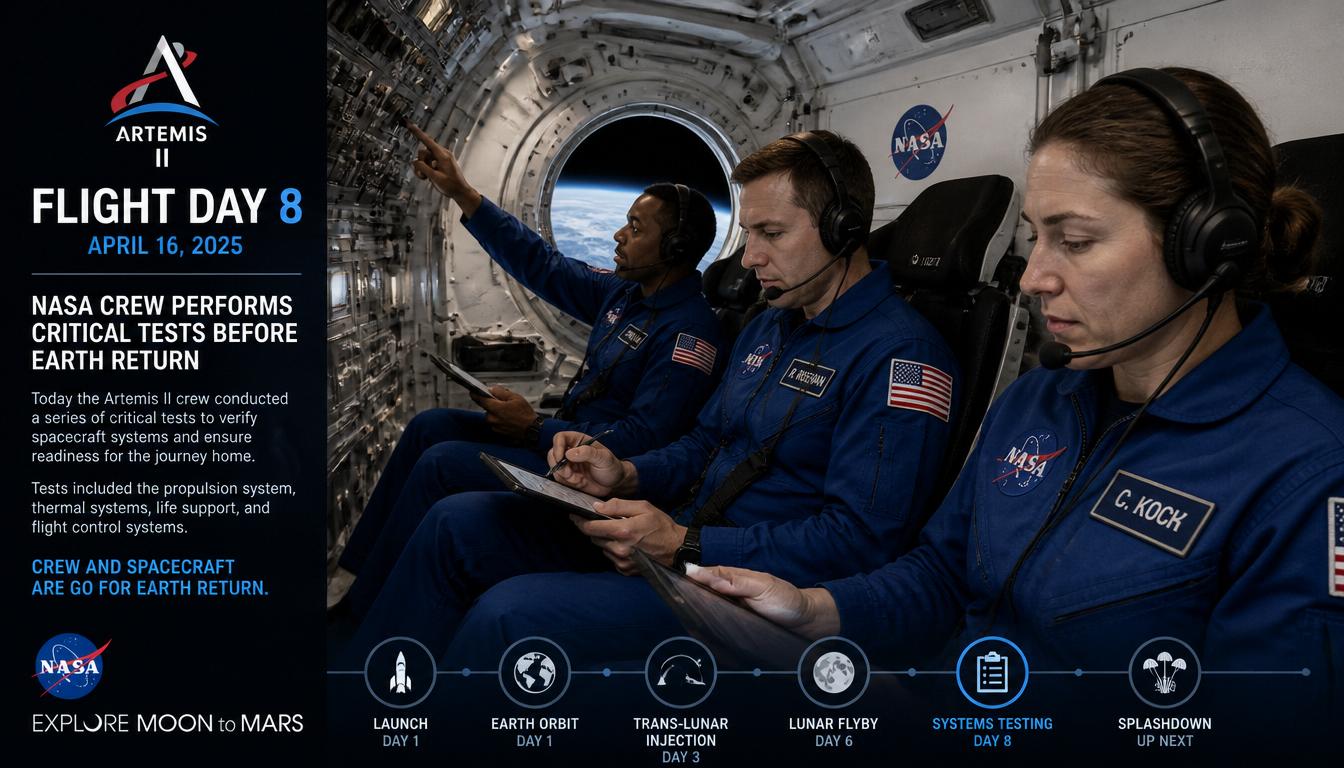
Artemis II Flight Day 8: NASA Crew Performs Critical Tests Before Earth Return
NASA’s Artemis II mission continues to achieve major milestones as the Orion spacecraft and its crew make their journey back to Earth after successfully flying around the Moon. Flight Day 8 focused on astronaut health, spacecraft handling tests, and preparations for splashdown in the Pacific Ocean.
The Artemis II astronauts are currently aboard the Orion spacecraft, named Integrity, and are carrying out several important tasks designed to improve future deep-space missions. As humanity moves closer to long-term lunar exploration, every activity performed during this mission provides valuable scientific and operational data for NASA and its international partners.
Following their historic lunar flyby, the crew is now safely traveling back toward Earth, with splashdown planned for April 10 off the coast of California. The mission continues to capture worldwide attention as NASA demonstrates advanced technologies and human spaceflight capabilities.
Artemis II Crew Continues Journey Home After Lunar Flyby
The Artemis II crew recently completed one of the mission’s most historic moments by traveling around the far side of the Moon. After leaving the lunar sphere of influence on April 7, the spacecraft officially began its return journey to Earth.
The lunar sphere of influence refers to the region where the Moon’s gravity affects the spacecraft more strongly than Earth’s gravity. Exiting this region marked an important transition point in the mission and confirmed that Orion is successfully traveling along its return trajectory.
Inside the spacecraft, the astronauts paused for a memorable group photo alongside their zero-gravity indicator named “Rise.” Zero-gravity indicators are symbolic objects carried during missions to demonstrate the effects of microgravity inside the spacecraft.
The crew members aboard Artemis II include NASA astronauts Reid Wiseman, Victor Glover, Christina Koch, and Canadian Space Agency astronaut Jeremy Hansen. Together, they continue performing experiments and flight demonstrations that will support future Moon missions under NASA’s Artemis program.
Crew Begins Flight Day 8 with Music and Mission Updates
The astronauts started Flight Day 8 with the song Under Pressure by Queen and David Bowie. Wake-up songs have become a long-standing NASA tradition that helps create a positive atmosphere for astronauts during demanding missions.
At the beginning of the day, Orion was approximately 200,278 miles from Earth and 83,549 miles from the Moon. These distances highlight the incredible scale of deep-space missions and the advanced navigation systems required to guide spacecraft safely across vast distances.
The crew also received a special message from the Canadian Space Agency, recognizing the contributions of Jeremy Hansen and celebrating international cooperation in space exploration.
Astronaut Health Remains a Major Mission Priority
Maintaining astronaut health during space missions is one of NASA’s top priorities. On Flight Day 8, the Artemis II crew continued their daily fitness routine using Orion’s flywheel exercise system.
Unlike traditional gym equipment on Earth, the flywheel system uses cable-based resistance to simulate exercises in microgravity conditions. Astronauts can perform activities such as rowing, squats, and deadlifts to maintain muscle strength and cardiovascular fitness.
Exercise becomes especially important during spaceflight because the human body changes significantly in microgravity. Without regular physical activity, astronauts may experience muscle loss, reduced bone density, and cardiovascular changes.
NASA carefully monitors astronaut fitness during missions to ensure crew members remain healthy and physically prepared for their return to Earth’s gravity.
Evaluating specialized suits for a secure journey back to Earth.
One of the most important activities on Flight Day 8 involved testing orthostatic intolerance garments. All four crew members took turns evaluating these specialized garments while wearing the Orion Crew Survival System suit.
Orthostatic intolerance is a condition that some astronauts experience after spending extended periods in microgravity. When astronauts return to Earth, gravity suddenly affects blood circulation again, which can cause dizziness, weakness, or fainting when standing upright.
The special garment applies pressure to the lower body, helping maintain healthy blood circulation and stable blood pressure during the transition back to Earth’s gravity.
These tests are extremely important because future missions to the Moon and Mars may involve even longer periods in space. NASA scientists use data from these experiments to improve astronaut safety and develop better technologies for future deep-space travel.
NASA Crew Prepares for Public Media Conference
The Artemis II astronauts also scheduled a live media event to speak about their mission experiences following the historic lunar flyby. The news conference allows journalists and audiences worldwide to hear directly from the crew about life aboard Orion and the challenges of deep-space travel.
Public communication plays an important role in modern space exploration. NASA uses live broadcasts, interviews, and mission coverage to inspire global audiences and encourage interest in science, engineering, and technology.
Millions of viewers continue following the Artemis II mission as humanity moves closer to returning astronauts to the Moon for the first time in decades.
Orion Spacecraft Manual Piloting Tests
Another major objective planned for Flight Day 8 involved manual spacecraft piloting demonstrations. During these exercises, the astronauts take direct control of Orion to evaluate its handling capabilities and navigation systems.
Using Orion’s viewing window, the crew was expected to align the spacecraft with a designated target before guiding Orion into a “tail-to-Sun” orientation. This position helps manage spacecraft temperatures and maximize power generation through the solar arrays.
Manual piloting tests are important because they allow astronauts to become familiar with spacecraft controls while also giving engineers valuable performance data.
Although mission controllers later decided to skip the scheduled manual piloting activity, the crew had already completed similar demonstrations earlier in the mission. Those earlier tests provided important information about Orion’s guidance and control systems.
Preparing Orion for Reentry and Splashdown
As the spacecraft gets closer to Earth, the Artemis II crew and flight control teams are now focusing on splashdown preparations. Returning safely from deep space requires careful planning and coordination between astronauts, engineers, and recovery teams.
The crew will begin securing equipment inside the spacecraft and reinstalling their seats for reentry. During splashdown, the spacecraft experiences intense forces and rapid deceleration, making it essential that all items inside the cabin are properly secured.
NASA officials also decided to cancel the originally planned radiation shielding demonstration in order to focus fully on entry preparations. Safety remains the agency’s highest priority during every stage of the mission.
The Artemis II splashdown is currently scheduled for 8:07 p.m. EDT on Friday, April 10, in the Pacific Ocean near San Diego, California.
Recovery Teams Ready for Orion Splashdown
As soon as Orion splashes down in the Pacific Ocean, recovery teams from NASA and the U.S. Navy will move quickly to assist the astronauts and retrieve the spacecraft.
The USS John P. Murtha will serve as the primary recovery ship during the operation. Teams aboard the vessel include divers, engineers, medical staff, and support personnel trained specifically for spacecraft recovery missions.
After splashdown, recovery crews will carefully secure Orion before helping the astronauts safely exit the capsule. The astronauts will then receive medical evaluations and transportation support following their deep-space journey.
Recovery operations are a critical part of every crewed mission because astronauts often need time to readjust after returning from microgravity environments.
Artemis II Advances the Future of Human Space Exploration
The Artemis II mission is one of NASA’s most important crewed missions in modern history. It represents the first crewed deep-space mission under the Artemis program and serves as a foundation for future lunar exploration.
NASA’s long-term goal is to establish a sustainable human presence on the Moon and eventually prepare for human missions to Mars. Every test conducted aboard Orion helps engineers improve spacecraft systems, astronaut safety procedures, and mission planning strategies.
The mission also demonstrates the importance of international partnerships in space exploration. The participation of the Canadian Space Agency highlights how global cooperation can support major scientific achievements.
As Artemis II continues its journey home, the mission remains a powerful symbol of human curiosity, innovation, and exploration.
Frequently Asked Questions (FAQs)
What is the Artemis II mission?
Artemis II is NASA’s first crewed mission under the Artemis program designed to test the Orion spacecraft during deep-space travel around the Moon.
Who are the astronauts aboard Artemis II?
The crew consists of Reid Wiseman, Victor Glover, Christina Koch, and Jeremy Hansen, an astronaut from the Canadian Space Agency.
What is the Orion spacecraft called?
The Orion spacecraft used during the mission is named Integrity.
Why are astronauts testing orthostatic intolerance garments?
These garments help astronauts maintain proper blood circulation and blood pressure when returning from space to Earth’s gravity.
What is the purpose of Orion’s manual piloting tests?
The manual piloting demonstrations allow astronauts to test spacecraft handling and navigation systems while gathering performance data.
When is the Artemis II splashdown scheduled?
NASA is targeting splashdown for April 10 in the Pacific Ocean near San Diego, California.
What is the role of the USS John P. Murtha?
The USS John P. Murtha will support recovery operations and help retrieve the Orion spacecraft and crew after splashdown.
Why is exercise important during space missions?
Astronauts exercise daily to prevent muscle loss, maintain bone strength, and support cardiovascular health in microgravity conditions.
1 comment