Artemis II Mission Update: Orion Spacecraft Successfully Completes Return Correction Burn in 2026

Updated
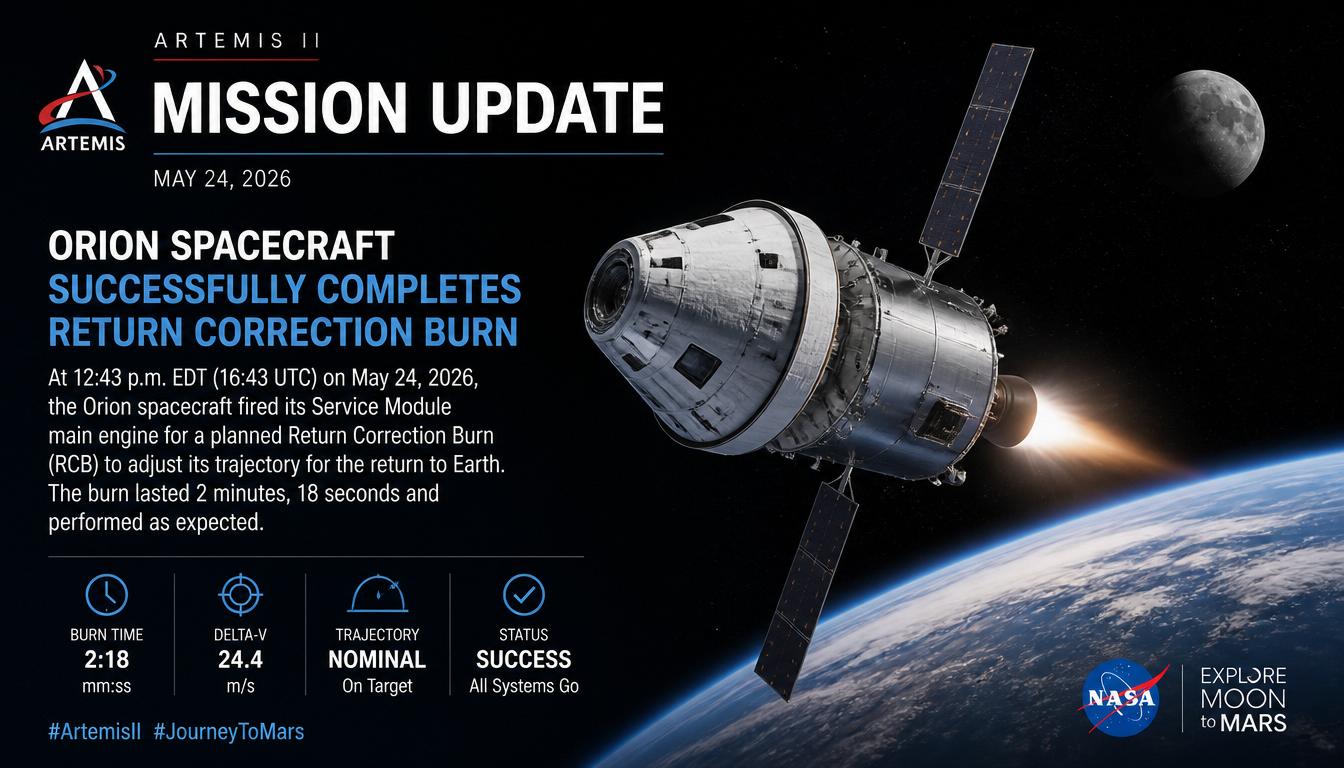
Artemis II Mission Update: Orion Spacecraft Successfully Completes Return Correction Burn in 2026
NASA’s Artemis II mission continues to move forward successfully as the Orion spacecraft completed an important maneuver during Flight Day 7. The mission represents another major step toward returning humans to deep space exploration and future Moon missions. During this phase of the journey, astronauts aboard Orion carried out several critical flight operations, including a return correction burn, spacecraft system monitoring, and preparation for Earth reentry activities.
The Artemis II crew members are actively testing advanced spaceflight systems and gathering valuable data that will help improve future lunar missions under NASA’s Artemis program. As the spacecraft travels through space on its journey back toward Earth, every operation plays a key role in ensuring mission safety and long-term success.
Orion Spacecraft Completes Important Return Correction Burn
One of the most significant events on Flight Day 7 was the successful completion of the mission’s first return correction burn. At exactly 8:03 p.m. EDT, the Orion spacecraft, officially named Integrity, fired its thrusters for approximately 15 seconds. This short but essential maneuver adjusted the spacecraft’s speed by 1.6 feet per second and helped align its course for a safe journey back to Earth.
Although the velocity change may seem small, these adjustments are extremely important during deep-space missions. Even a tiny correction can significantly affect the spacecraft’s final trajectory over long distances. NASA engineers carefully planned the burn to ensure Orion remains on the correct path toward its targeted recovery area in the Pacific Ocean.
The correction burn also demonstrated Orion’s navigation and propulsion capabilities, which are vital for future crewed lunar missions and eventually human exploration of Mars.
Astronauts Monitor Spacecraft Systems During Maneuver
While the spacecraft performed the burn, NASA astronaut Christina Koch and Canadian Space Agency astronaut Jeremy Hansen closely monitored Orion’s systems and operational data. During the maneuver, the astronauts went over mission procedures, checked navigation data, and monitored the spacecraft’s configuration.
Space missions require constant teamwork between astronauts and mission control teams on Earth. Every operation is carefully supervised to reduce risks and maintain spacecraft stability. Koch and Hansen played an important role in ensuring that all systems performed as expected during the return correction process.
The successful operation provided mission teams with valuable information about Orion’s performance in deep space conditions.
New Lunar Flyby Images Shared by NASA
During the daily mission briefing, NASA officials also revealed the first stunning images captured by the Artemis II crew during their lunar flyby. These images offered breathtaking views of the Moon and highlighted the success of Orion’s onboard camera systems.
The release of these images generated excitement among space enthusiasts worldwide. Lunar flybys are among the most visually impressive moments in any space mission because they provide rare perspectives of the Moon from a crewed spacecraft.
NASA continues to use imagery not only for public engagement but also for scientific observations and technical analysis. The photographs help engineers study spacecraft orientation, lighting conditions, and camera performance during different mission stages.
Recovery Operations Begin for Artemis II Splashdown
As the Artemis II mission progresses, NASA has already started preparing for the spacecraft’s recovery after reentry. Officials confirmed that the USS John P. Murtha has departed port and is now traveling toward the recovery zone in the Pacific Ocean.
Recovery teams are responsible for retrieving the Orion capsule after it safely splashes down in the ocean. These teams include Navy personnel, NASA specialists, divers, engineers, and medical staff who work together to support the astronauts immediately after landing.
Preparing recovery operations in advance is extremely important because weather conditions, ocean currents, and spacecraft positioning must all be carefully monitored. NASA stated that additional updates regarding recovery preparations and environmental conditions will continue to be shared during future mission briefings.
Crew Members Prepare for Busy Flight Operations
After completing Flight Day 7 activities, the Artemis II astronauts prepared for a full night of rest before continuing with additional mission objectives. Space missions follow carefully designed schedules that balance operational work with astronaut health and recovery time.
The following day’s schedule included multiple important tests and demonstrations related to spacecraft handling, astronaut health, and Earth-return preparations. Each activity is designed to provide NASA with critical information that will improve future missions.
Long-duration spaceflight places unique demands on the human body, which is why astronauts regularly perform health-related evaluations throughout the mission.
Astronauts Test Special Garments for Earth Gravity Transition
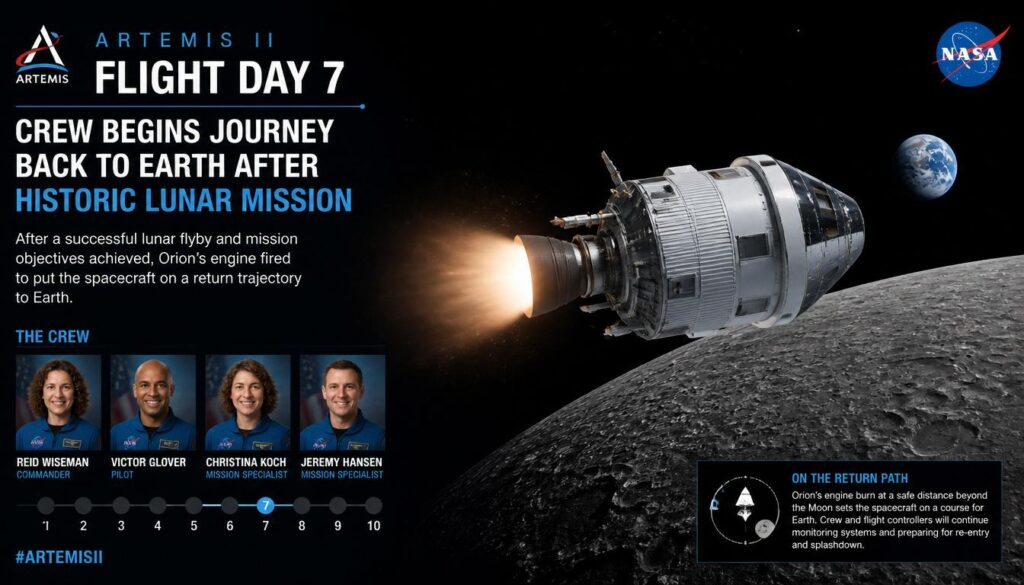
One of the upcoming flight tests involves evaluating orthostatic intolerance garments. NASA astronauts Reid Wiseman, Victor Glover, Christina Koch, and Jeremy Hansen are scheduled to participate in this important experiment.
These specialized garments are designed to help astronauts adapt when returning from space to Earth’s gravity. During space missions, the human body experiences changes in blood circulation because microgravity reduces the effects of gravity on the cardiovascular system.
When astronauts return to Earth, some may experience dizziness or difficulty maintaining blood pressure while standing. The orthostatic intolerance garments help improve circulation and support stable blood flow during the transition back to normal gravity conditions.
Testing these garments allows NASA to improve astronaut safety and comfort during future long-duration missions to the Moon and beyond.
Orion Manual Piloting Demonstration Planned
Another major task scheduled for the Artemis II crew is a manual piloting demonstration using the Orion spacecraft. During this operation, astronauts will temporarily take manual control of the spacecraft and use Orion’s viewing system to align with a designated target.
The demonstration allows astronauts to evaluate Orion’s handling and compare different spacecraft control modes. NASA uses these tests to verify that astronauts can effectively operate the spacecraft if manual control becomes necessary during future missions.
The crew will also guide Orion into a “tail to Sun” orientation, which is an important positioning technique used to manage spacecraft temperature and solar energy collection.
Manual piloting exercises are critical because they help astronauts develop operational familiarity while providing engineers with performance data about spacecraft responsiveness.
Artemis II marks the beginning of a new age in space exploration.
The Artemis II mission is much more than a routine spaceflight. It marks one of NASA’s most important crewed missions in recent years and serves as a foundation for future lunar exploration.
NASA’s Artemis program aims to return humans to the Moon, establish sustainable lunar operations, and eventually prepare for missions to Mars. Artemis II is the first crewed test flight of the Orion spacecraft beyond low Earth orbit and demonstrates technologies needed for deep-space travel.
The mission also highlights international cooperation in space exploration through partnerships with agencies like the Canadian Space Agency. By working together, countries can combine resources, expertise, and technology to achieve ambitious exploration goals.
Every successful maneuver, experiment, and system test during Artemis II brings humanity one step closer to long-term space exploration.
NASA Continues Providing Live Mission Coverage
NASA is actively sharing mission updates, images, and live coverage with audiences around the world. Space enthusiasts can follow real-time developments through NASA’s social media platforms, official website, and YouTube broadcasts.
Public engagement remains an important part of the Artemis program because it inspires future generations of scientists, engineers, and explorers. Millions of people continue following the mission as astronauts journey through deep space aboard Orion.
The Artemis II mission not only advances scientific discovery but also reminds the world of humanity’s ongoing passion for exploration and innovation.
Frequently Asked Questions (FAQs)
What was the purpose of the return correction burn in Artemis II?
The return correction burn adjusted Orion’s trajectory and ensured the spacecraft remains on the correct path back to Earth safely.
How long did the Orion thrusters fire during the maneuver?
The spacecraft’s thrusters fired for approximately 15 seconds during the return correction burn.
What is the name of the Orion spacecraft used in Artemis II?
The Orion capsule used for Artemis II has been named Integrity.
Why are astronauts testing orthostatic intolerance garments?
These garments help astronauts maintain blood pressure and proper circulation when transitioning from space back to Earth’s gravity.
Why is the Artemis II mission important?
Artemis II is NASA’s first crewed deep-space mission in the Artemis program and plays a major role in preparing for future Moon and Mars exploration.
Who are the astronauts participating in Artemis II?
The mission crew includes Reid Wiseman, Victor Glover, Christina Koch, and Jeremy Hansen.
What is the role of the USS John P. Murtha in the mission?
The USS John P. Murtha is part of the recovery operation and will help retrieve the Orion spacecraft after splashdown in the Pacific Ocean.
Why is manual spacecraft piloting important?
Manual piloting demonstrations help astronauts practice spacecraft control and allow NASA to test Orion’s handling capabilities for future missions.
1 comment