BREAKING: Artemis II Flight Day 9: Orion Crew Gets Ready for Historic Return to Earth

Updated
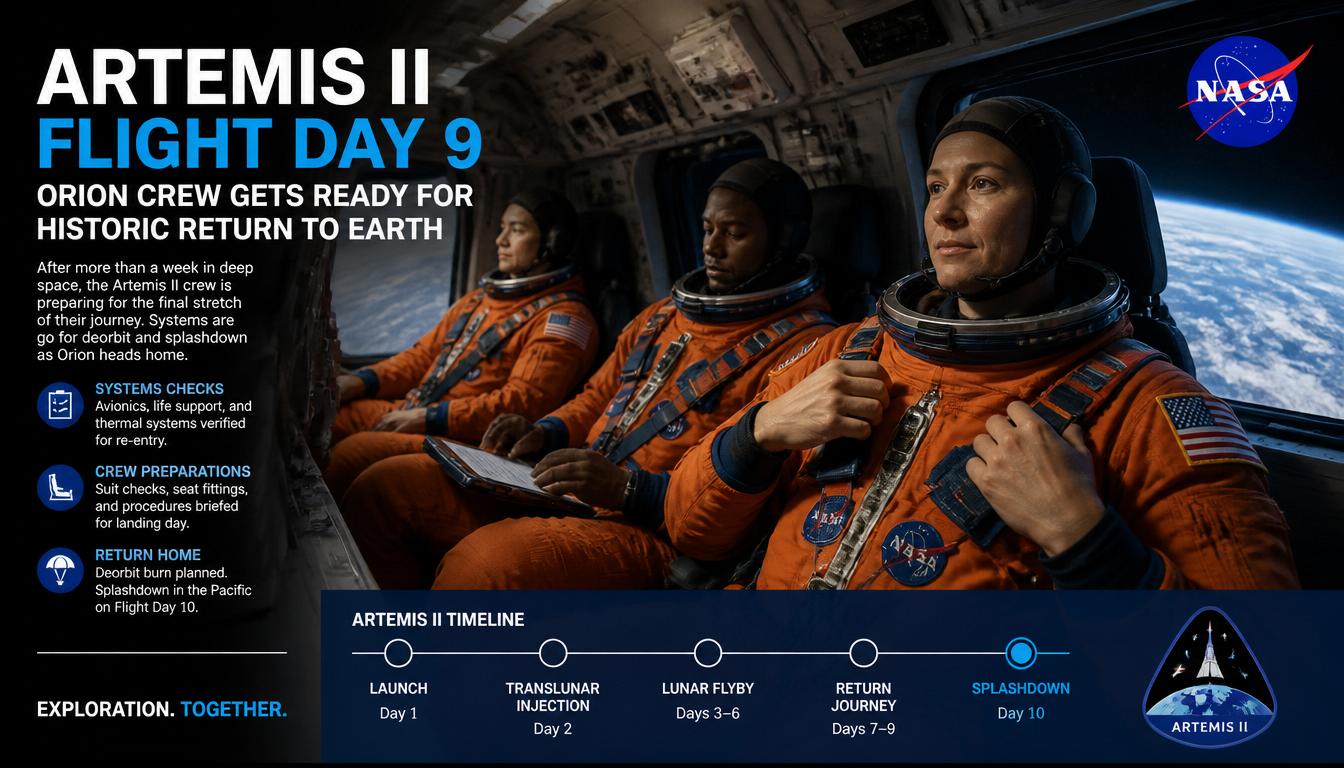
Artemis II Flight Day 9: Orion Crew Gets Ready for Historic Return to Earth
NASA’s Artemis II mission is approaching its dramatic conclusion as the Orion spacecraft and its crew prepare for re-entry and splashdown after completing a successful journey around the Moon. Flight Day 9 marks the astronauts’ final full day in space before returning to Earth, ending one of the most significant human spaceflight missions of recent years.
After traveling deep into space and circling the far side of the Moon, the Artemis II astronauts are now focused on final spacecraft preparations, trajectory adjustments, and splashdown procedures. The mission continues to provide NASA with critical information that will support future Moon landings and long-duration space exploration missions.
Inside the Orion spacecraft, named Integrity, the crew members are carrying out important operational tasks while mission control teams on Earth coordinate recovery operations in the Pacific Ocean.
Artemis II Mission Nears Completion After Successful Lunar Journey
The Artemis II crew officially began their return to Earth after leaving the Moon’s sphere of influence on April 7. This important milestone confirmed that Earth’s gravity once again became the dominant force guiding Orion back home.
The astronauts aboard the mission include NASA commander Reid Wiseman, pilot Victor Glover, mission specialist Christina Koch, and Canadian Space Agency astronaut Jeremy Hansen. The crew was selected in 2023 and spent nearly three years training together for this historic deep-space mission.
Their journey around the Moon represents the first crewed lunar flyby mission under NASA’s Artemis program and serves as a major stepping stone toward future lunar landings.
As Flight Day 9 started, the astronauts woke up to the song Lonesome Drifter by Charley Crockett while traveling approximately 147,337 miles from Earth.
NASA’s tradition of using music to wake astronauts helps create a positive atmosphere during long and demanding missions.
Crew Focuses on Re-Entry Preparations Inside Orion
One of the primary objectives during Flight Day 9 involves preparing the spacecraft cabin for atmospheric re-entry and splashdown. Astronauts Christina Koch and Jeremy Hansen are leading efforts to organize equipment, secure cargo, and configure Orion for landing.
Spacecraft cabins must be carefully arranged before re-entry because the astronauts will experience significant physical forces during descent. Every piece of equipment inside the capsule needs to be safely secured to avoid movement during splashdown.
The crew is also reinstalling and adjusting their seats to ensure proper support during landing. While astronauts float freely in microgravity during the mission, re-entry subjects them to intense acceleration and gravitational forces.
Throughout the day, the astronauts are reviewing weather updates, landing timelines, and emergency procedures while coordinating with recovery teams on Earth.
These detailed preparations help ensure the astronauts can safely transition from deep space travel back to Earth’s environment.
Orion Set to Perform Another Trajectory Correction Burn
As Orion continues traveling toward Earth, NASA scheduled another return trajectory correction burn to fine-tune the spacecraft’s path.
The maneuver is planned for 9:53 p.m. EDT and will involve a short firing of Orion’s thrusters. Although these adjustments may seem minor, they are extremely important because even small trajectory errors can create major changes over long distances.
The correction burn helps align Orion perfectly for atmospheric entry and splashdown in the Pacific Ocean.
During the operation, Jeremy Hansen will closely monitor Orion’s guidance, navigation, and propulsion systems while reviewing procedural checklists.
These navigation maneuvers demonstrate the advanced capabilities of Orion’s deep-space flight systems and help validate technologies that will eventually support missions to Mars.
NASA Finalizes Splashdown Recovery Operations
While the astronauts prepare inside Orion, NASA teams on Earth are making final arrangements for splashdown and recovery operations.
The agency is targeting splashdown at approximately 8:07 p.m. EDT on Friday, April 10, off the coast of San Diego, California. Recovery crews from NASA, the U.S. Navy, and the U.S. Air Force are already stationed near the designated landing zone.
Recovery operations are among the most carefully planned parts of any crewed mission because astronaut safety remains the highest priority.
NASA continues providing regular mission updates and detailed briefings to the public through its official broadcasts and online coverage platforms.
The mission has captured global attention as millions of people follow Orion’s historic journey home from deep space.
Orion Service Module Will Separate Before Re-Entry
Before entering Earth’s atmosphere, Orion must complete one of the most critical phases of the mission — service module separation.
The service module provides propulsion, oxygen, electrical power, and water throughout the mission. However, it is not designed to survive atmospheric entry and must detach before the crew capsule begins re-entry.
NASA plans to separate the service module at approximately 7:33 p.m., about 20 minutes before Orion reaches the upper atmosphere southeast of Hawaii.
Shortly after separation, Orion will perform a final trajectory adjustment burn to ensure the spacecraft follows the correct entry path.
The capsule will then begin a series of controlled roll maneuvers to safely distance itself from the discarded hardware and stabilize its orientation for descent.
Orion Will Experience Extreme Heat and Speed During Re-Entry
As Orion approaches Earth, the spacecraft will reach extraordinary speeds of nearly 23,864 miles per hour before entering the atmosphere.
Returning from lunar missions generates far more heat than missions returning from low Earth orbit because the spacecraft travels much faster during entry.
Orion’s advanced heat shield is specifically engineered to withstand these extreme temperatures and protect the astronauts inside the capsule.
At approximately 400,000 feet above Earth, the spacecraft will enter a planned six-minute communications blackout. During this phase, intense heat creates plasma around Orion, temporarily blocking radio signals between the crew and mission control.
The astronauts are expected to experience forces of up to 3.9 Gs during descent, meaning they will briefly feel nearly four times their normal body weight.
Although physically challenging, these forces remain within safe operational limits for the crew.
Orion’s Parachute System Will Slow the Spacecraft for Landing
Following the communications blackout, Orion will begin deploying its parachute systems to slow the spacecraft before splashdown.
The first parachutes to deploy will be Orion’s drogue parachutes at approximately 22,000 feet above the ocean. These smaller parachutes stabilize the spacecraft and reduce speed before the main parachutes open.
Moments later, at around 6,000 feet, Orion’s three massive main parachutes will fully deploy.
These parachutes are designed to safely slow the capsule for water landing in the Pacific Ocean. NASA engineers spent years testing the parachute system under various conditions to ensure maximum safety and reliability.
The successful deployment of Orion’s parachutes is one of the most important steps during the final phase of the mission.
Recovery Teams Prepare to Assist Artemis II Astronauts
Once Orion splashes down in the Pacific Ocean, specially trained recovery teams will move quickly to assist the crew.
The USS John P. Murtha will serve as the main recovery ship for the mission. Helicopters, divers, medical teams, and engineering specialists are already positioned near the recovery area.
Within two hours after splashdown, the astronauts are expected to be safely extracted from Orion and transported by helicopter to the USS John P. Murtha.
After arriving aboard the ship, the crew will undergo post-mission medical evaluations and begin adjusting to Earth’s gravity again after their deep-space journey.
Eventually, the astronauts will travel back to NASA’s Johnson Space Center in Houston for additional recovery activities and mission debriefings.
Artemis II Represents a New Era in Human Space Exploration
The Artemis II mission is one of NASA’s most important achievements in modern space exploration. It marks the agency’s first crewed deep-space mission in decades and serves as a major milestone in returning humans to the Moon.
NASA’s Artemis program aims to establish sustainable human exploration on the lunar surface and prepare astronauts for future missions to Mars.
Every system tested during Artemis II — from navigation and propulsion to life support and re-entry operations — provides valuable information for future exploration missions.
The mission also demonstrates the importance of international partnerships, particularly NASA’s collaboration with the Canadian Space Agency.
As Orion prepares to return home, Artemis II continues inspiring millions of people worldwide and proving that humanity’s journey into deep space is entering an exciting new era.
Frequently Asked Questions (FAQs)
What is the Artemis II mission?
Artemis II is NASA’s first crewed deep-space mission under the Artemis program designed to send astronauts around the Moon and back to Earth.
Who are the Artemis II crew members?
The members of the crew are Reid Wiseman, Victor Glover, Christina Koch, and Jeremy Hansen, who is an astronaut with the Canadian Space Agency.
What is the Orion spacecraft called?
The Orion spacecraft used during Artemis II is named Integrity.
Why are trajectory correction burns important?
Trajectory correction burns are used to fine-tune Orion’s flight path, ensuring precise navigation and a safe re-entry into the atmosphere.
What happens during Orion’s communications blackout?
As the spacecraft re-enters the atmosphere, plasma builds up around it from extreme heat, which briefly cuts off communication with mission control.
How fast will Orion travel during re-entry?
Orion is expected to reach speeds of approximately 23,864 miles per hour before entering Earth’s atmosphere.
What is the role of Orion’s parachutes?
The parachutes slow the spacecraft safely before splashdown in the Pacific Ocean.
Where will Artemis II splash down?
The spacecraft is scheduled to splash down in the ocean close to San Diego, California.
What is the USS John P. Murtha?
The recovery vessel that will help the Artemis II crew after splashdown is the USS John P. Murtha.
What makes Artemis II significant for upcoming space missions?
The mission helps NASA test technologies and procedures needed for future Moon landings and eventual missions to Mars.