6 Serious Space Industry Cybersecurity Threats and the Best Ways to Stay Safe


Space Industry Cybersecurity Threats:
Modern satellites function as sophisticated computer systems orbiting hundreds of miles overhead, making them genuinely vulnerable to the same kinds of digital attacks threatening terrestrial computer networks. Space industry cybersecurity threats have grown into a serious operational concern as satellites increasingly handle critical infrastructure functions across communication, navigation, and defense applications.
1. Signal Jamming Remains One of the Most Common Attack Methods
Among the most persistent space industry cybersecurity threats, signal jamming involves deliberately interfering with satellite communication frequencies, a relatively low-tech but genuinely disruptive attack method that has affected both civilian and military satellite operations.
2. Spoofing Attacks Can Deceive Navigation and Positioning Systems
Space industry cybersecurity threats include increasingly sophisticated spoofing attacks, where malicious actors transmit false signals designed to deceive GPS and other navigation systems discussed throughout related satellite technology analysis into reporting inaccurate position data.
3. Ground Station Infrastructure Represents a Genuine Vulnerability Point
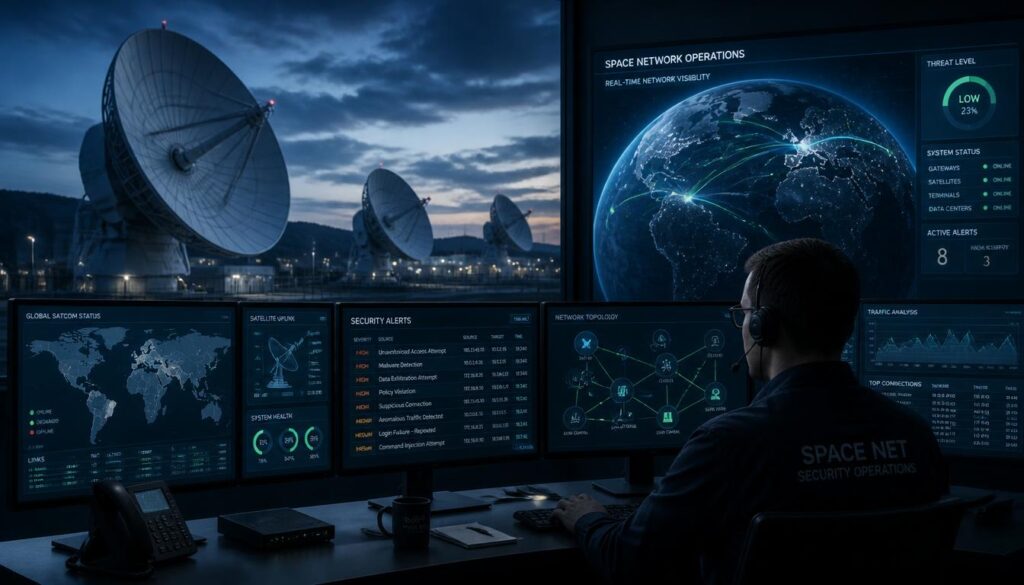
Beyond the satellites themselves, space industry cybersecurity threats extend to ground station infrastructure, since compromising these terrestrial command and control facilities can potentially provide attackers pathways to interfere with satellite operations without directly attacking the spacecraft.
4. Supply Chain Vulnerabilities Create Additional Attack Surface Concerns
Reflecting broader cybersecurity industry concerns, these threats increasingly include supply chain vulnerability considerations, since compromised components introduced during manufacturing could theoretically create security weaknesses difficult to detect after satellite deployment.
5. Nation-State Actors Represent a Genuinely Sophisticated Threat Category
These threats include particularly sophisticated capability from nation-state actors, whose resources and technical capability considerably exceed typical criminal hacking groups, creating especially concerning risk for critical government and military satellite systems.
6. Industry Response Increasingly Includes Dedicated Cybersecurity Standards and Requirements
Reflecting genuine institutional recognition of these risks, these threats have prompted increasingly formal industry response, including dedicated cybersecurity standards and requirements incorporated into satellite design and operational procedures.
Why These Threats Carry Such Significant Implications for Critical Infrastructure
Space industry cybersecurity threats carry genuine significance extending well beyond individual satellite operators, since compromised satellite systems could potentially disrupt critical infrastructure spanning telecommunications, navigation, weather forecasting, and defense applications that modern society has come to fundamentally depend upon.
This critical infrastructure dependency explains why cybersecurity increasingly receives serious attention throughout satellite design and operational planning, reflecting genuine recognition that these systems require the same rigorous security consideration applied to other essential infrastructure categories like power grids and financial systems.
The Viasat Cyberattack of 2022
On February 24, 2022, the day Russia invaded Ukraine, a cyberattack disabled tens of thousands of satellite internet modems on Viasat’s KA-SAT network across Europe. Investigators linked it to malware called AcidRain, and Western governments attributed it to Russia.
The attack also knocked out remote monitoring of thousands of wind turbines in Germany, showing how satellite hacks can spread to other sectors.
Interference With US Satellites
A 2011 US congressional commission report described incidents in 2007 and 2008 when hackers interfered with two US government Earth observation satellites, Landsat-7 and Terra, through a ground station.
The report highlighted vulnerabilities in ground systems.
GPS Spoofing at Sea
In 2017, ships in the Black Sea reported their GPS showing them at an inland airport, a sign of spoofing. Since then, spoofing incidents have been widely reported near conflict zones.
Aviation authorities have warned pilots about false GPS signals.
Hack-A-Sat Competitions
The US Air Force and Space Force have run Hack-A-Sat competitions at the DEF CON security conference since 2020. In 2023, teams attempted to hack a real satellite in orbit, called Moonlighter.
These events help find vulnerabilities before real attackers do.
NASA’s Raspberry Pi Breach
In 2018, hackers accessed NASA’s Jet Propulsion Laboratory network through an unauthorised Raspberry Pi computer. They stole data before being discovered.
The incident showed how small weak points can be exploited.
Space Policy Directive-5
In 2020, the US issued Space Policy Directive-5, setting cybersecurity principles for space systems, including encryption and protection against jamming.
It encourages operators to build security into designs.
Space ISAC
The Space Information Sharing and Analysis Center was founded in 2019 to help companies share information about cyber threats.
Collaboration helps the industry respond faster.
Starlink Under Jamming Attacks
Starlink faced jamming attempts in Ukraine and pushed software updates to resist them.
The episode showed how quickly satellite systems can adapt.
Supply Chain Risks
Components from untrusted suppliers could contain hidden vulnerabilities. Companies screen suppliers and test hardware.
Governments restrict some foreign components.
Encryption and Authentication
Encrypting commands and data protects satellites from unauthorised control. Galileo’s authentication service is one example of protecting signals.
Older satellites often lack such protections.
Growing Awareness
Awareness of space cyber risks has grown quickly.
Why Satellites Are Attractive Targets
Satellites support navigation, communication, banking, weather forecasting and military operations, so disrupting them can cause damage far beyond the space industry. Attackers may aim to steal data, disrupt services or take control of spacecraft. Because many satellites were designed years ago with little attention to cybersecurity, older systems can be particularly vulnerable to modern attack techniques.
Ground Stations as the Front Door
Most cyberattacks on space systems target the ground rather than the satellite itself. Ground stations, control centres and user terminals connect to ordinary computer networks, which hackers can probe using familiar methods such as phishing emails, stolen passwords and unpatched software. Securing these ground systems is therefore one of the most important steps operators can take.
Nation-State Actors
Governments with advanced cyber capabilities are considered the most serious threat to space systems, since they have the resources to develop sophisticated tools. Military planners now treat cyber operations against satellites as a realistic part of modern conflict, as the Viasat attack at the start of the war in Ukraine demonstrated.
Designing Security From the Start
New satellites increasingly include encryption, authentication of commands and the ability to update software securely in orbit. Building security in from the design stage is far easier than adding it later, and customers such as governments now often require it in contracts.
Incident Reporting
Regulations increasingly require operators to report cyber incidents, helping governments understand threats and coordinate responses.
How the Industry Continues Developing Better Defenses Against These Evolving Threats
In response to these threats, satellite operators and manufacturers continue developing improved defensive capability, including enhanced encryption, more robust authentication systems, and improved monitoring for detecting potential attack attempts before they cause significant operational disruption.
This ongoing defensive development reflects the broader pattern of cybersecurity representing a continuous, evolving challenge rather than a problem that can be permanently solved through any single technical solution, requiring sustained industry attention and investment as attack techniques and defensive capabilities both continue advancing over time.
Keep exploring with our guides to space industry cybersecurity insurance, satellite anti-jamming military technology and GPS satellite modernization program. For official information, visit NASA’s official site.
Frequently Asked Questions
What is signal jamming?
Deliberately interfering with satellite communication frequencies, a common and disruptive attack method.
What are spoofing attacks?
Transmitting false signals designed to deceive navigation systems into reporting inaccurate position data.
Are ground stations vulnerable too?
Yes, compromising terrestrial command and control facilities can provide attackers pathways to interfere with satellites.
Do nation-states pose a special threat?
Yes, their resources and technical capability considerably exceed typical criminal hacking groups.
How is the industry responding to these threats?
Through increasingly formal cybersecurity standards and requirements incorporated into satellite design and operations.