Artemis II Flight Day 7: Crew Begins Inspiring Journey Back to Earth After Historic Lunar Mission Triumph

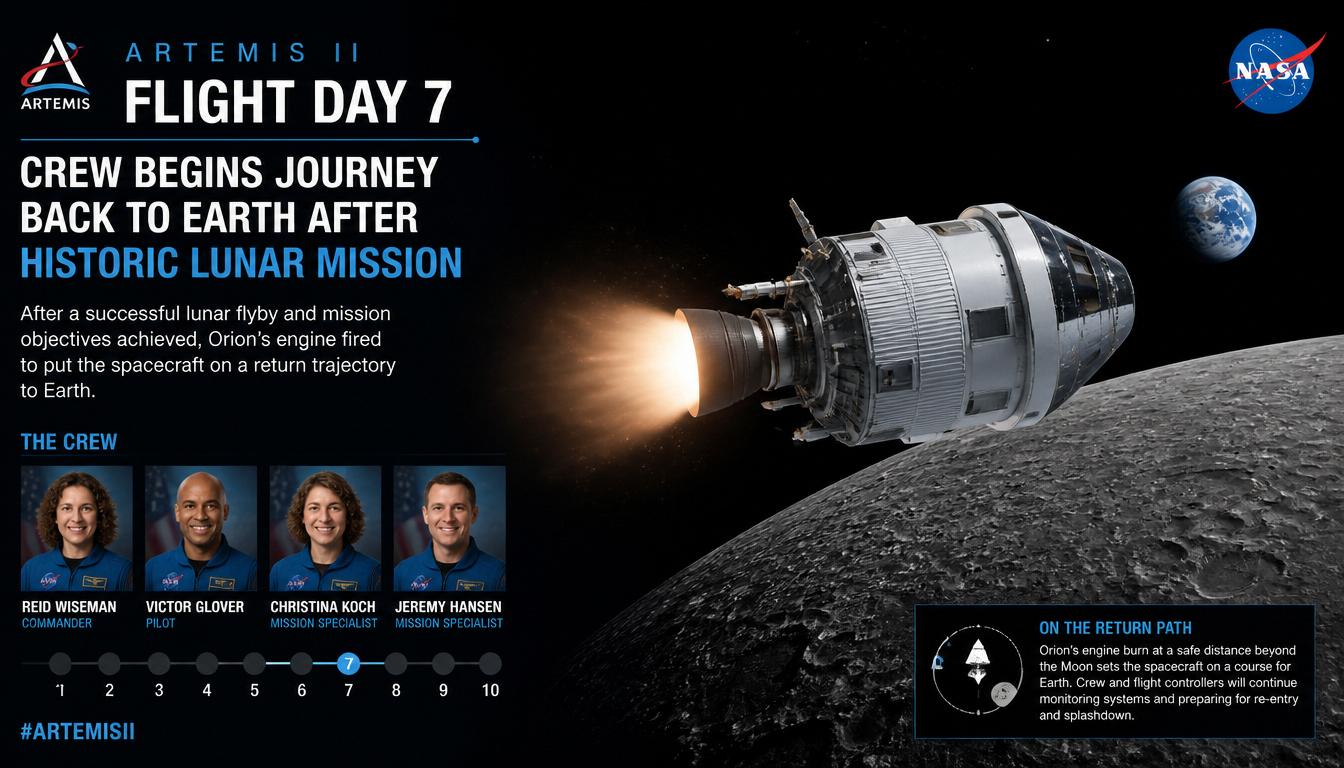
Artemis II Flight Day 7: Crew Begins Inspiring Journey Back to Earth After Historic Lunar Mission Triumph
The incredible journey of Artemis II Mission continues as the astronauts aboard the Orion spacecraft officially begin their return trip to Earth after completing a historic lunar flyby. Flight Day 7 marked an important transition for the crew as they moved away from the Moon and prepared for the next phase of the mission.
After becoming the first humans to travel around the Moon since Apollo 17 in 1972, the Artemis II astronauts are now focused on safely returning home while continuing scientific observations and mission operations in deep space.
The mission has already broken records, captured breathtaking views of Earth and the Moon, and provided scientists with valuable data for future lunar exploration missions.
Artemis II Crew Wakes Up After Historic Lunar Flyby
Following one of the most important days in modern space exploration, the Artemis II crew woke up aboard Orion ready to begin the return journey toward Earth.
At the start of Flight Day 7, the astronauts were approximately 36,286 miles away from the Moon and over 236,000 miles from Earth.
The crew began the day listening to the song “Tokyo Drifting” by Glass Animals and Denzel Curry, continuing NASA’s long tradition of using music to wake astronauts during space missions.
Although the excitement of the lunar flyby had passed, the mission remained extremely important as NASA continued testing deep-space travel systems and astronaut operations far beyond Earth orbit.
Orion Exits the Moon’s Sphere of Influence
One of the biggest milestones during Flight Day 7 occurred when the Orion spacecraft exited the Moon’s sphere of influence.
This event marked the moment when the Moon’s gravity no longer had the strongest pull on the spacecraft. Instead, Orion officially shifted back into Earth’s gravitational influence as it continued the long trip home.
The transition happened at approximately 1:23 p.m. EDT.
Leaving the lunar sphere of influence is a critical navigation milestone because it confirms that the spacecraft is correctly following its planned trajectory back to Earth.
NASA engineers carefully monitor these transitions to ensure the spacecraft remains on a safe and efficient flight path.
Stunning Earthset Image Captures Global Attention
One of the most unforgettable moments of the mission came when NASA released breathtaking images captured during the lunar flyby.
The Earthset image showed Earth slowly disappearing behind the cratered lunar horizon as seen through Orion’s windows.
In the photograph, Earth appeared as a soft blue globe covered with bright white clouds while parts of the planet experienced nighttime darkness. Swirling cloud systems over Australia and Oceania were also visible.
The foreground of the image featured the Ohm crater, a large lunar crater with terraced walls and central peaks formed during a massive impact event billions of years ago.
These images quickly became symbolic of humanity’s return to deep-space exploration.
Rare Solar Eclipse Observed from Deep Space
NASA and the White House also released remarkable images of the solar eclipse witnessed by the Artemis II crew.
From Orion’s perspective, the Moon completely blocked the Sun for nearly 54 minutes, creating a spectacular total eclipse deep in space.
The eclipse revealed the Sun’s glowing corona, which is normally hidden by the Sun’s brightness. Astronauts were able to observe details of the corona more clearly than would typically be possible from Earth.
The images also captured stars surrounding the darkened Moon — something rarely visible in normal lunar photography.
Scientists are especially interested in the solar corona because it influences solar storms and space weather, which can affect satellites, communication systems, and future astronauts traveling through deep space.
This eclipse became one of the most extraordinary observations of the Artemis II mission.
Artemis II Crew Contacts International Space Station from Far Away
On Flight Day 7, another distinctive event took place when the Artemis II astronauts had a direct spacecraft-to-spacecraft conversation with the crew living on the International Space Station.
The Orion crew spoke with:
- Jessica Meir
- Jack Hathaway
- Chris Williams
- Sophie Adenot
The astronauts shared their experiences from the lunar flyby and discussed life during space missions.
This communication highlighted the cooperation between different space missions and international space agencies working together to expand human exploration beyond Earth.
The call was broadcast live through NASA’s YouTube channel, allowing viewers worldwide to listen to the historic conversation.
Lunar Science Debrief Helps Future Moon Missions
Prior to Orion traveling too far from the Moon, the Artemis II crew took part in a scientific review with NASA specialists back on Earth.
Scientists were eager to hear the crew’s firsthand impressions while the lunar observations were still fresh in their minds.
During the discussion, astronauts described the Moon’s surface features, color variations, textures, and lighting conditions they observed during the flyby.
This information is extremely valuable because direct human observations can sometimes reveal details that cameras and instruments may miss.
The data collected during Artemis II will help scientists prepare for future Moon landings and long-term lunar exploration.
NASA plans to use these findings to improve astronaut training, spacecraft systems, and scientific objectives for upcoming Artemis missions.
Crew Takes Time to Rest During Return Journey
After several intense days of mission activities, NASA scheduled staggered off-duty periods for the crew.
Space missions require astronauts to maintain both physical and mental health, especially during long journeys far from Earth.
The rest period allowed the crew to recover after the demanding lunar flyby operations and prepare for the next series of return-flight tasks.
Even while they are resting, the astronauts remain in a carefully managed environment aboard Orion, where every action is thoroughly scheduled and observed.
Managing astronaut fatigue and maintaining crew performance are essential parts of long-duration space missions.
Orion Begins Return Trajectory Correction Burns
As Orion continued its journey home, NASA prepared for one of the mission’s most important technical operations — the first return trajectory correction burn.
At approximately 9:03 p.m. EDT, Orion’s thrusters were scheduled to ignite in order to adjust the spacecraft’s flight path toward Earth.
Trajectory correction burns are extremely important because even small navigation errors in deep space can lead to major problems over long distances.
During the burn, astronauts Christina Koch and Jeremy Hansen monitored spacecraft systems and reviewed procedures to ensure the maneuver was completed successfully.
NASA plans to conduct three separate correction burns during Orion’s return journey.
These adjustments help guarantee a safe reentry and splashdown back on Earth.
Why Artemis II Is a Historic Mission
The Artemis II mission is considered one of the most important human spaceflight missions in decades.
The mission successfully demonstrated:
- Human deep-space travel capabilities
- Long-distance crew communication systems
- Lunar observation techniques
- Navigation beyond Earth orbit
- Crew safety procedures in deep space
- Spacecraft performance near the Moon
The success of Artemis II is helping NASA prepare for future missions that will land astronauts on the Moon again for the first time since the Apollo era.
It also supports long-term goals of building a sustainable human presence on the Moon and eventually sending astronauts to Mars.
The Artemis Program and what lies ahead for space exploration.
The Artemis program represents NASA’s next major chapter in space exploration.
Future Artemis missions aim to:
- Return astronauts to the lunar surface
- Build lunar bases
- Test technologies for Mars missions
- Expand international cooperation in space
- Develop long-term human exploration systems
Artemis II represents an essential milestone in reaching these ambitious objectives.
By successfully completing the lunar flyby and beginning the safe return journey home, the mission has already become a historic success.
FAQs About Artemis II Flight Day 7
What is Artemis II?
NASA Artemis II is the first crewed mission in NASA’s Artemis program designed to send astronauts around the Moon aboard the Orion spacecraft.
What happened on Artemis II Flight Day 7?
The crew began their return journey to Earth after completing the lunar flyby and exiting the Moon’s sphere of influence.
What is Orion spacecraft?
Orion Spacecraft Orion is NASA’s advanced spacecraft developed for human missions beyond Earth orbit.
What is the Moon’s sphere of influence?
It is the region where the Moon’s gravity has a stronger pull on the spacecraft than Earth’s gravity.
Why are trajectory correction burns important?
These engine burns help adjust Orion’s flight path to ensure a safe and accurate return to Earth.
Who did Artemis II astronauts call from space?
The crew communicated with astronauts aboard the International Space Station, including Jessica Meir and Sophie Adenot.
Why was the solar eclipse observation important?
The eclipse allowed astronauts to study the Sun’s corona and capture rare deep-space images.
Did Artemis II land on the Moon?
No, Artemis II only performed a lunar flyby and did not land on the lunar surface.
Conclusion
Flight Day 7 of the Artemis II mission marked the beginning of Orion’s long journey back to Earth after a historic trip around the Moon. From breathtaking Earthset images to deep-space communication with astronauts aboard the International Space Station, the mission continues to inspire people around the world.
As NASA prepares for future lunar landings and eventual Mars missions, Artemis II has proven that humanity is once again capable of exploring deep space and pushing the boundaries of human achievement.