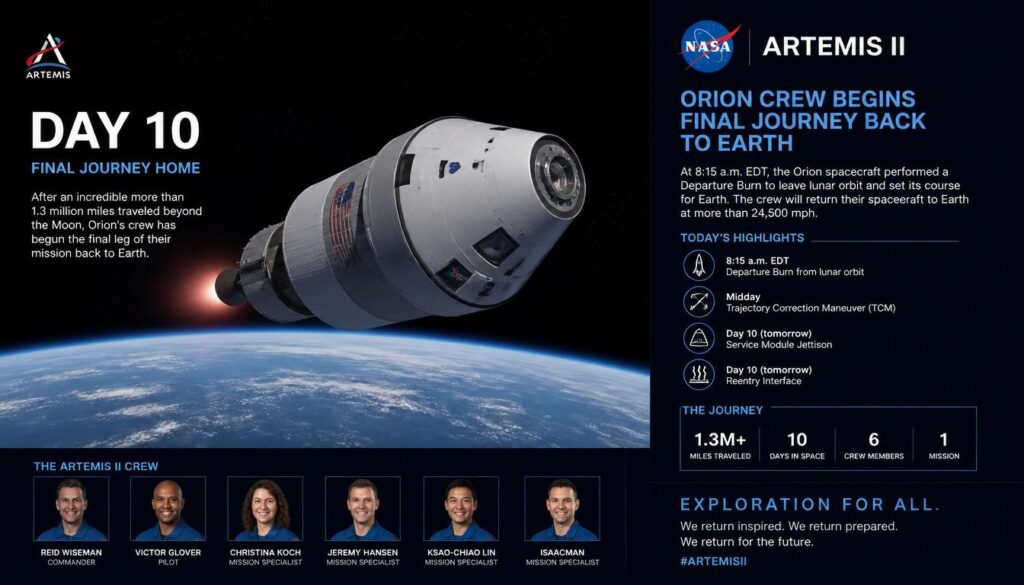
Artemis II Flight Day 10: Orion Performs Final Burn as Crew Prepares for Earth Return

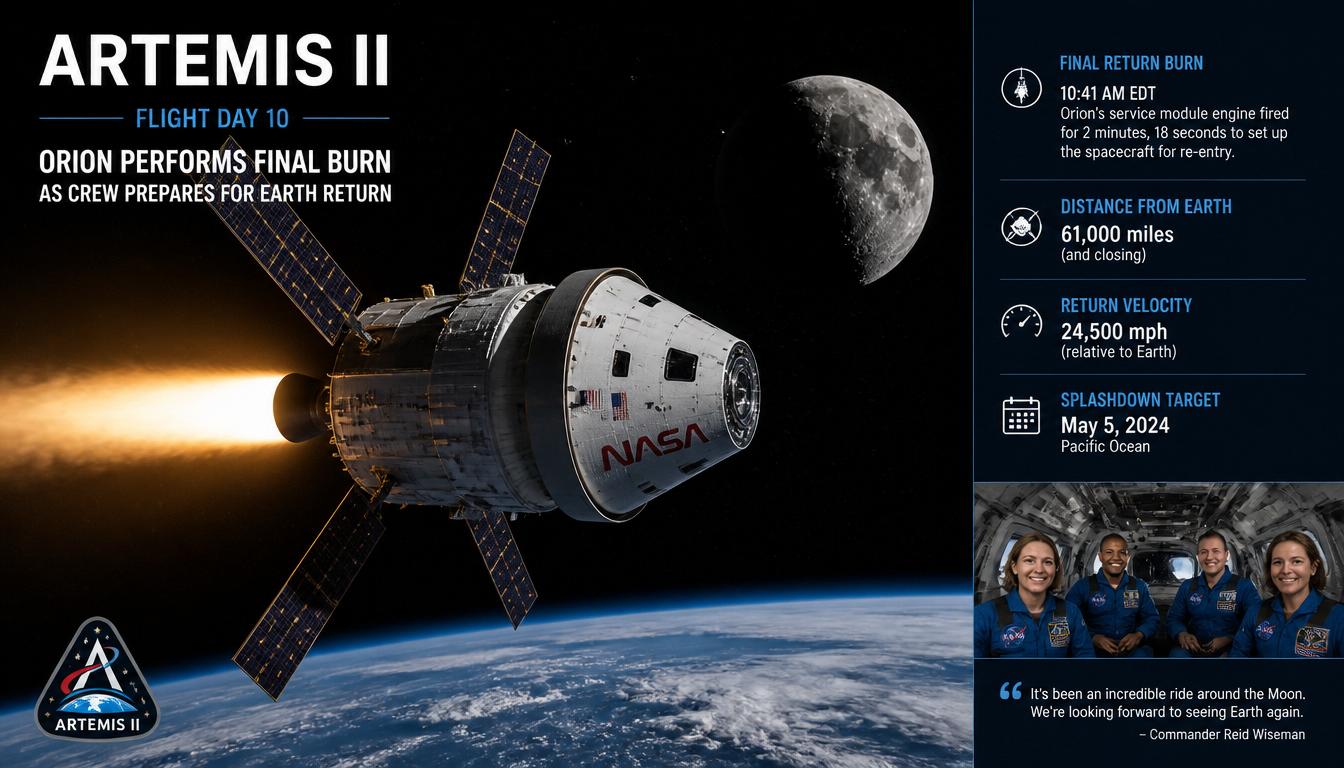
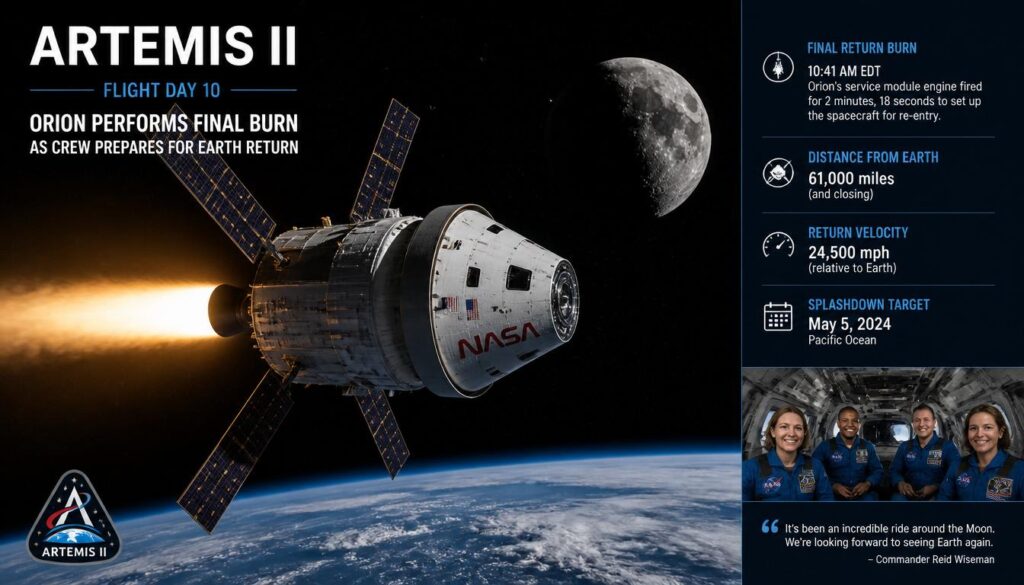
Artemis II Flight Day 10: Orion Performs Final Burn as Crew Prepares for Earth Return
NASA’s Artemis II mission has reached its most critical and emotional stage as the Orion spacecraft performs its final trajectory adjustment before returning to Earth. Flight Day 10 marks the final push home for the crew after completing a historic journey around the Moon.
The Orion spacecraft, carrying NASA astronauts Reid Wiseman, Victor Glover, Christina Koch, and Canadian Space Agency astronaut Jeremy Hansen, is now fully committed to re-entry and splashdown operations. After days of deep-space exploration, the mission is approaching its final destination: a safe landing in the Pacific Ocean.
This final phase of Artemis II highlights the precision, teamwork, and advanced technology required for human space exploration beyond Earth orbit.
Final Return Burn Brings Orion onto Earth-Targeted Path
One of the most important operations of Flight Day 10 was the final return trajectory correction burn.
At 2:53 p.m. EDT, Orion’s thrusters fired for approximately eight seconds, producing a velocity change of 4.2 feet per second. Although this may seem like a small adjustment, it plays a major role in ensuring the spacecraft is perfectly aligned for atmospheric entry.
This final burn fine-tunes Orion’s path toward Earth and ensures the spacecraft enters the atmosphere at the correct angle and speed. Even a slight miscalculation in deep space could significantly affect the landing location, making this maneuver essential for mission success.
During the burn, astronauts onboard carefully monitored spacecraft systems, navigation data, and propulsion performance to ensure everything operated as expected.
NASA engineers confirmed that the spacecraft responded correctly, marking another successful step toward splashdown.
Artemis II Crew Prepares for Historic Return Home
As Orion approaches Earth, the crew has shifted its focus entirely to re-entry procedures and splashdown readiness.
The astronauts aboard include:
- Reid Wiseman (Commander)
- Victor Glover (Pilot)
- Christina Koch (Mission Specialist)
- Jeremy Hansen (CSA Mission Specialist)
Together, they have spent several days traveling back from the Moon after completing a groundbreaking lunar flyby mission.
Now, they are working through detailed entry checklists to ensure every system inside the spacecraft is properly configured for re-entry. This includes securing equipment, preparing seats, and verifying cabin safety protocols.
These final preparations are critical because the spacecraft will soon experience extreme heat, pressure, and gravitational forces during its descent into Earth’s atmosphere.
Cabin Configuration and Re-Entry Checklist Completion
One of the key tasks during Flight Day 10 is preparing Orion’s interior for re-entry.
The crew is carefully stowing loose equipment, securing storage compartments, and making sure all items are locked into place. This prevents movement inside the capsule during high-force re-entry conditions.
Astronauts are also adjusting their seats into final landing positions. These seats are specially designed to protect the crew during splashdown and reduce the impact of landing forces.
In addition, the crew is reviewing entry procedures step-by-step to ensure they are fully prepared for each phase of descent, including heat shield entry, parachute deployment, and ocean landing.
Mission control teams on Earth are working closely with the astronauts to confirm that all systems are properly configured for the return journey.
Splashdown Targeted for Pacific Ocean Recovery
NASA is targeting splashdown for 8:07 p.m. EDT (5:07 p.m. PDT) off the coast of San Diego, California.
This marks the end of Orion’s long journey through deep space, which includes a historic lunar flyby and a return trajectory spanning hundreds of thousands of miles.
Once Orion lands in the ocean, NASA’s recovery teams will be ready to assist immediately. These teams include specialists from NASA, the U.S. Navy, and the Department of Defense.
Recovery ships and helicopters will quickly move in to secure the spacecraft and ensure the astronauts are safely extracted.
The USS John P. Murtha will serve as the primary recovery vessel, where the crew will undergo initial medical checks and post-mission evaluations.
Live Coverage and Global Viewing Experience
NASA is providing live coverage of the entire return and splashdown process across multiple platforms, allowing people worldwide to follow the mission in real time.
Live streaming is available on:
- NASA+
- Amazon Prime Video
- Apple TV
- Netflix
- HBO Max
- Discovery+
- Peacock
- Roku
Coverage begins at 6:30 p.m. EDT and continues until the crew is safely recovered and transported to the USS John P. Murtha.
NASA also provides updates through social media channels and its official YouTube livestream, ensuring global access to mission events.
This wide coverage highlights the importance of Artemis II as a global scientific and technological milestone.
Orion’s Role in Advancing Deep Space Exploration
The Artemis II mission is not just a return journey—it is a full test of NASA’s Orion spacecraft in deep space conditions.
Throughout the mission, Orion has successfully demonstrated its ability to:
- Navigate beyond low Earth orbit
- Support human life in deep space
- Perform precise orbital corrections
- Safely prepare for atmospheric re-entry
These achievements are crucial for future missions under NASA’s Artemis program, which aims to establish long-term human presence on the Moon and eventually support missions to Mars.
Every maneuver completed during Artemis II provides valuable data that will improve spacecraft design, safety systems, and mission planning for future explorers.
Precision Navigation Ensures Safe Return
Deep space travel requires extremely accurate navigation systems. Even minor errors in trajectory can lead to major deviations over long distances.
That is why NASA performs multiple correction burns during the return journey. Each burn helps refine Orion’s position and ensures it follows a safe path toward Earth.
The final burn completed on Flight Day 10 is especially important because it locks in the spacecraft’s entry angle and ensures it reaches the correct landing corridor in the Pacific Ocean.
NASA engineers continuously monitor velocity, altitude, and spacecraft orientation to guarantee a safe return for the crew.
Artemis II: A Historic Step Toward the Future
Artemis II represents a major milestone in human space exploration. It is the first crewed mission to travel around the Moon since the Apollo era, marking a return to deep space after more than 50 years.
The mission demonstrates NASA’s commitment to advancing science, technology, and international collaboration in space exploration.
It also serves as a foundation for future Artemis missions that will land astronauts on the Moon and prepare humanity for exploration beyond Earth.
As Orion completes its final burn and prepares for splashdown, Artemis II stands as a symbol of human innovation, courage, and discovery.
Frequently Asked Questions (FAQs)
What is the purpose of the final return burn in Artemis II?
The final return burn fine-tunes Orion’s trajectory to ensure a precise and safe re-entry into Earth’s atmosphere.
How long did the final burn last?
The thrusters fired for approximately eight seconds during the maneuver.
How much velocity change did the burn produce?
The burn produced a velocity change of about 4.2 feet per second.
Who are the astronauts on Artemis II?
Reid Wiseman, Victor Glover, Christina Koch, and Jeremy Hansen make up the crew.
Where will Artemis II splash down?
The spacecraft is scheduled to splash down in the Pacific Ocean off the coast of San Diego.
Why is cabin configuration important before re-entry?
Cabin configuration ensures all equipment is secured to prevent movement during high-force atmospheric entry.
What time does splashdown occur?
Splashdown is targeted for 8:07 p.m. EDT.
Where can people watch Artemis II live coverage?
NASA is streaming the mission on NASA+, Amazon Prime, Apple TV, Netflix, HBO Max, Discovery+, Peacock, Roku, and YouTube.
What role does Orion play in the Artemis program?
Orion is the spacecraft designed to carry astronauts on deep-space missions beyond Earth orbit, including missions to the Moon and Mars.
What role does Artemis II play in shaping future space missions?
It tests critical systems needed for long-duration human space exploration and future lunar landing missions.