INCREDIBLE: Artemis II Flight Day 10: Live Re-Entry, Splashdown, and Crew Recovery Updates

INCREDIBLE: Artemis II Flight Day 10: Live Re-Entry, Splashdown, and Crew Recovery Updates
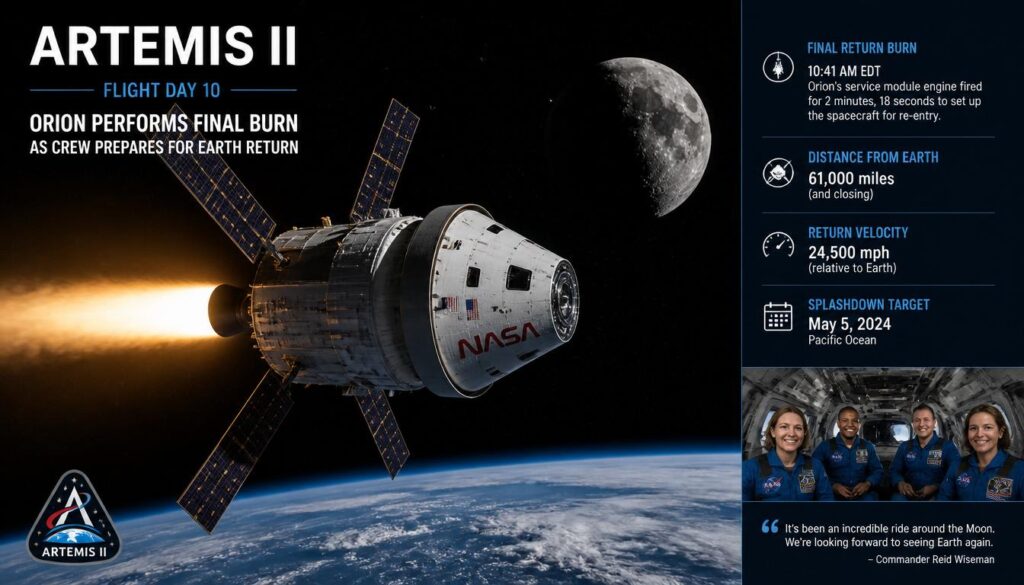
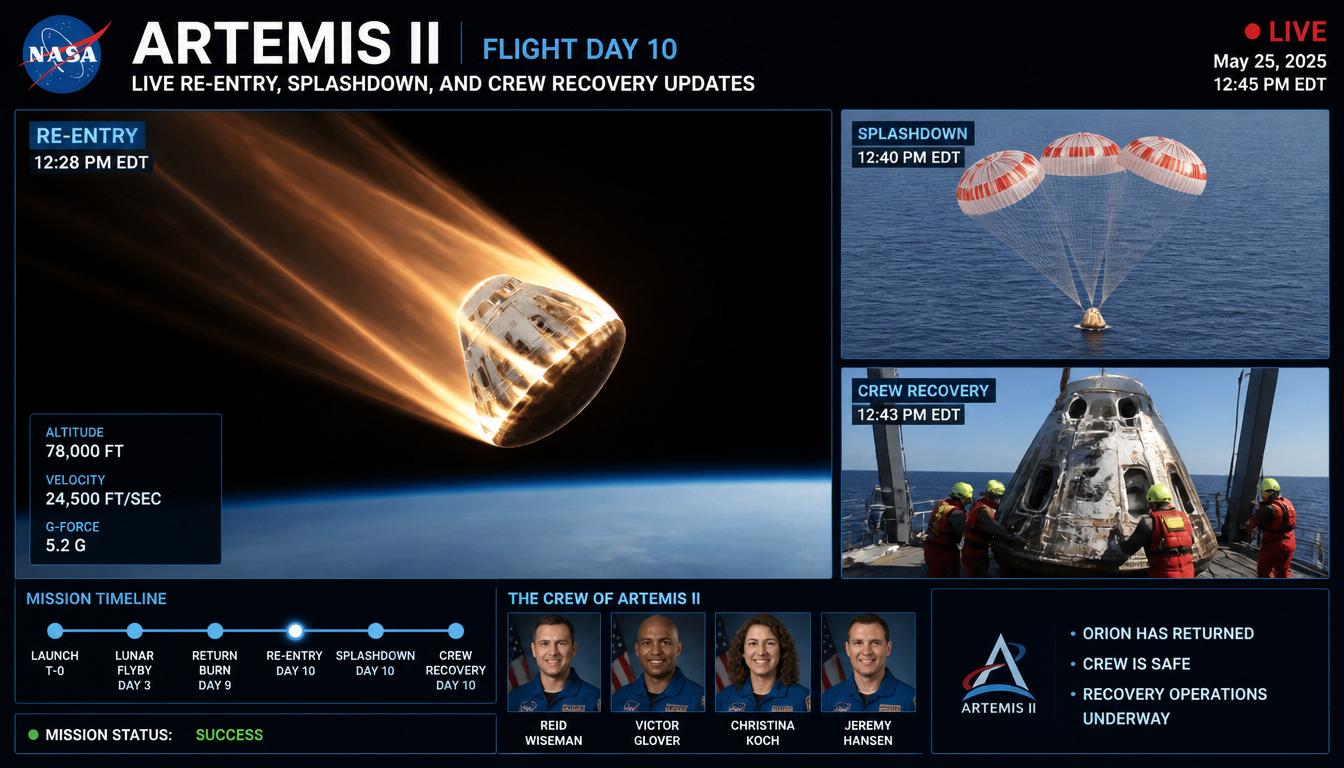
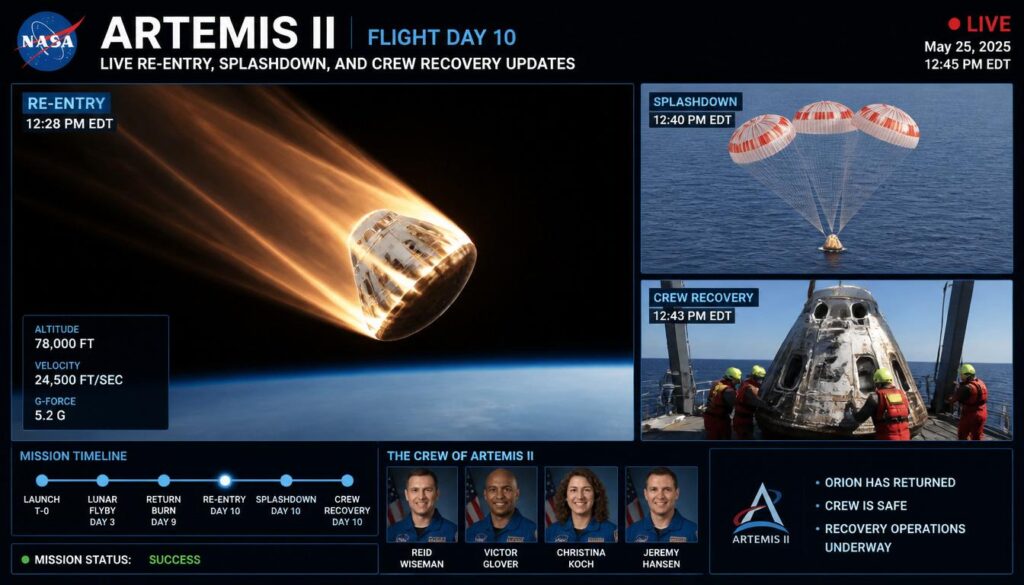
NASA’s Artemis II mission reached its most dramatic and historic conclusion on Flight Day 10 as the Orion spacecraft successfully completed re-entry and splashed down in the Pacific Ocean. This final phase marked the end of a nearly 10-day deep space journey around the Moon and the beginning of astronaut recovery operations at sea.
The mission carried NASA astronauts Reid Wiseman, Victor Glover, Christina Koch, and Canadian Space Agency astronaut Jeremy Hansen, making it the first crewed lunar flyby mission in over five decades. As Orion returned to Earth, NASA provided continuous live updates covering every stage—from atmospheric entry to crew recovery aboard the USS John P. Murtha.
This article presents a structured breakdown of the full re-entry timeline, technical milestones, and recovery operations that brought Artemis II safely back home.
Final Phase of Artemis II Mission Begins
As Flight Day 10 progressed, Orion entered its final approach toward Earth. The spacecraft was traveling at extreme speeds after completing its lunar flyby and return trajectory.
Mission controllers confirmed that all systems were functioning normally as the spacecraft prepared for atmospheric entry. The crew inside Orion shifted into re-entry configuration, ensuring all equipment was secured and systems were ready for the intense heating and gravitational forces ahead.
At this stage, the mission transitioned from deep-space operations to high-risk atmospheric descent procedures.
Communication Handovers and Pre-Re-Entry Operations
Before re-entry, Orion successfully transitioned communication systems from NASA’s Deep Space Network to the Near Space Network’s Tracking and Data Relay Satellites.
This maintained an uninterrupted link with mission control while the spacecraft drew closer to Earth.
Maintaining communication during this phase is critical because engineers must monitor:
- spacecraft orientation
- speed and trajectory
- heat shield performance
- crew safety conditions
Shortly after this transition, the spacecraft completed a service module separation maneuver. The crew module continued toward Earth while the service module was set to burn up safely in the atmosphere over the Pacific Ocean.
This separation is a key milestone in all Orion return missions.
Crew Module Separation Marks Start of Re-Entry
The crew module of Orion detached from the service module at around 7:33 p.m. EDT.
This separation was essential because only the crew capsule is designed to survive Earth’s atmospheric re-entry. The service module, which powered the spacecraft during the mission, is not reusable after separation.
After separation, the crew module initiated its guided descent toward Earth, directed by accurate navigation systems.
NASA confirmed that the debris from the service module would burn up harmlessly over the Pacific Ocean, ensuring no risk to populated areas or shipping routes.
Heat Shield Alignment and Entry Burn
At 7:37 p.m., Orion performed the crew module raise burn.
This maneuver adjusted the spacecraft’s angle to properly align the heat shield for atmospheric entry. The heat shield is one of the most important components of the spacecraft, designed to withstand temperatures reaching thousands of degrees Fahrenheit.
Proper alignment ensures:
- safe re-entry angle
- controlled descent path
- maximum thermal protection
Without this correction, the spacecraft could enter at an unsafe trajectory, risking structural damage or mission failure.
Atmospheric Entry and Extreme Re-Entry Conditions
At 7:53 p.m., Orion entered Earth’s atmosphere at an altitude of approximately 400,000 feet.
At this moment, the spacecraft was traveling at around 35 times the speed of sound. This marked the beginning of the most intense phase of the mission.
As Orion hit the upper atmosphere:
- plasma formed around the capsule
- temperatures increased rapidly
- communication signals were temporarily blocked
This caused a planned six-minute communications blackout between the spacecraft and mission control.
During this phase, astronauts experienced intense physical forces and heating conditions as the spacecraft transitioned from space to atmospheric flight.
Communications Blackout and High-G Forces
During re-entry, Orion entered a communications blackout caused by ionized plasma surrounding the capsule.
This is a normal and expected phenomenon during high-speed atmospheric entry.
At the same time, astronauts experienced strong gravitational forces (up to 3.9 Gs), meaning they felt nearly four times their body weight.
Despite these extreme conditions, the spacecraft remained stable and on course, demonstrating Orion’s advanced aerodynamic and thermal protection systems.
Once the plasma dissipated, communication with NASA was successfully restored.
Parachute Deployment and Final Descent
As Orion continued descending, its speed gradually decreased and parachute deployment began.
At approximately 23,400 feet:
- drogue parachutes deployed
- spacecraft stabilized
- velocity reduced significantly
At around 5,400 feet:
- drogue parachutes detached
- three main parachutes deployed
- final descent phase began
The main parachutes slowed Orion to less than 136 mph, ensuring a safe ocean landing.
This precisely timed parachute deployment process ranks among the most vital safety features in the Orion spacecraft’s design.
Splashdown in the Pacific Ocean
At 8:07 p.m. EDT, Orion successfully splashed down in the Pacific Ocean off the coast of San Diego, California.
This marked the official completion of the Artemis II space mission.
After splashdown:
- engineers conducted safety checks
- spacecraft systems were powered down
- recovery teams moved in for extraction
Orion’s descent was described as stable and fully successful, completing a historic return from lunar orbit.
Crew Recovery Operations Begin at Sea
Immediately after splashdown, NASA and U.S. military recovery teams began coordinated operations.
Key steps included:
- approach using inflatable boats
- attachment of recovery cables
- stabilization of the capsule
- preparation for crew extraction
Following that, U.S. Navy helicopters came to pick up the astronauts from the ocean and take them to the USS John P. Murtha, the main recovery ship.
Once aboard, the astronauts underwent initial medical evaluations to assess their health after long-duration spaceflight and re-entry stress.
Transfer to USS John P. Murtha and Post-Mission Care
After recovery, the astronauts were safely transported to the USS John P. Murtha.
Onboard the ship:
- medical teams conducted health checks
- astronauts were monitored for re-adaptation to gravity
- initial post-flight interviews and procedures began
Following shipboard recovery, the crew was scheduled to return to shore and board a NASA aircraft bound for Johnson Space Center in Houston, Texas.
This phase marks the beginning of post-mission analysis and rehabilitation.
Mission Achievements and Scientific Value
Artemis II was not only a successful flight but also a major scientific and engineering milestone.
Key achievements include:
- The first crewed flight past the Moon in more than five decades.
- successful deep-space navigation tests
- validated Orion spacecraft systems
- demonstrated safe Earth re-entry capability
The mission provides critical data for future Artemis missions, including upcoming lunar landings and long-term Moon exploration programs.
NASA engineers will now analyze spacecraft performance to improve future designs and mission safety.
Importance of Artemis II for Future Space Exploration
Artemis II is a stepping stone toward NASA’s long-term goal of establishing human presence on the Moon and preparing for Mars exploration.
The mission demonstrated:
- reliable deep-space human travel
- safe return from lunar orbit
- advanced spacecraft autonomy
- international collaboration in space exploration
These achievements strengthen NASA’s Artemis program and bring humanity closer to sustained lunar exploration.
Frequently Asked Questions (FAQs)
What was Artemis II Flight Day 10 about?
It covered the final re-entry, splashdown, and crew recovery operations of the Orion spacecraft.
When did Orion splash down?
At 8:07 p.m. EDT, Orion landed in the Pacific Ocean near San Diego.
What happens during crew module separation?
The crew module separates from the service module so the capsule can safely re-enter Earth’s atmosphere.
Why did Orion experience a communication blackout?
A plasma layer formed around the spacecraft during re-entry, blocking radio signals temporarily.
How fast was Orion during re-entry?
It traveled at approximately 35 times the speed of sound.
What are drogue parachutes used for?
They stabilize and slow the spacecraft before main parachute deployment.
Where were astronauts recovered after splashdown?
They were recovered by helicopters and transported to the USS John P. Murtha.
What is the purpose of Artemis II?
It is a crewed test mission to validate Orion’s performance in deep space.
What will happen to Orion after landing?
It will be transported for inspection and post-flight analysis at NASA facilities.
Why is Artemis II important?
It marks a major step toward future Moon missions and long-term human exploration of space.