Exciting Artemis II Flight Day 10: Orion Crew Begins Final Journey Back to Earth

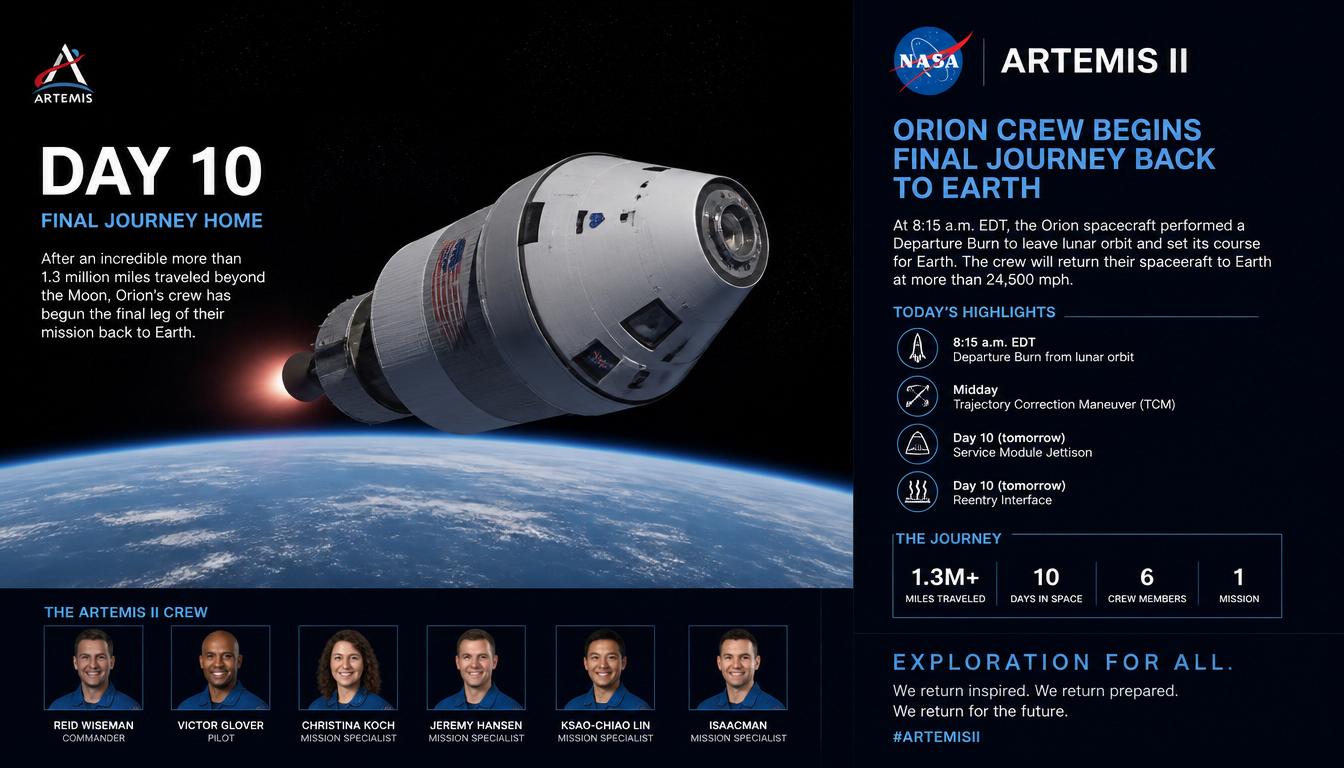
Exciting Artemis II Flight Day 10: Orion Crew Begins Final Journey Back to Earth
NASA’s Artemis II mission is entering its final and most dramatic phase as the Orion spacecraft prepares for atmospheric re-entry and splashdown in the Pacific Ocean. After successfully traveling around the Moon and completing a historic deep-space mission, the four astronauts aboard Orion are now making their final preparations to return home.
Flight Day 10 represents the conclusion of one of NASA’s most important crewed missions in modern history. The mission marks humanity’s return to the Moon’s vicinity for the first time in more than five decades and serves as a major milestone for the Artemis program.
As Orion approaches Earth, NASA astronauts Reid Wiseman, Victor Glover, Christina Koch, and Canadian Space Agency astronaut Jeremy Hansen continue carrying out final spacecraft procedures, trajectory adjustments, and re-entry preparations.
The world is now watching closely as NASA prepares to complete another historic chapter in human space exploration.
Artemis II Crew Begins Final Day in Deep Space
The Artemis II astronauts started Flight Day 10 with music selected to mark the emotional final phase of their mission. The crew woke up to the songs Run to the Water by Live and Free by Zac Brown Band while traveling approximately 61,326 miles from Earth.
Music has long been part of NASA’s astronaut traditions and helps create a calm and positive environment during demanding missions.
The astronauts aboard Orion include commander Reid Wiseman, pilot Victor Glover, mission specialist Christina Koch, and Canadian Space Agency astronaut Jeremy Hansen. Together, they have spent the past several days performing critical mission tasks, scientific observations, and spacecraft evaluations while traveling through deep space.
During Flight Day 10, the crew shifted its full attention toward re-entry operations and splashdown procedures.
NASA recovery teams and military personnel are already stationed near the Pacific Ocean recovery zone off the coast of San Diego, California, where Orion is scheduled to land later in the evening.
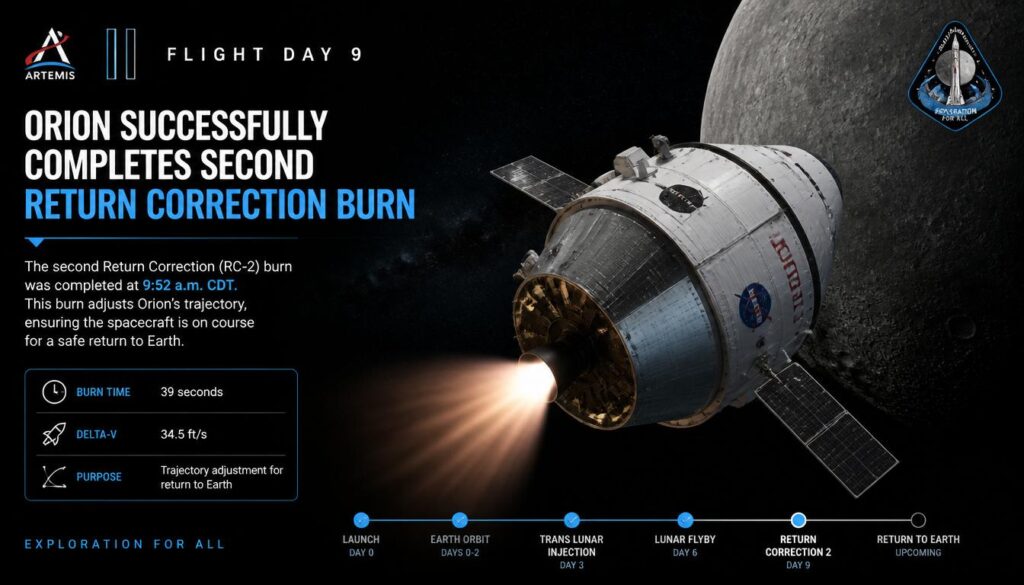
Third Return Correction Burn Prepares Orion for Re-Entry
One of the most important operations on Flight Day 10 is Orion’s third and final return trajectory correction burn.
Scheduled for 2:53 p.m., this maneuver is designed to fine-tune Orion’s path before the spacecraft enters Earth’s atmosphere. Although the burn itself is relatively short, it plays a critical role in ensuring the spacecraft follows the correct re-entry corridor.
Navigating through deep space demands exceptional accuracy, since even minor errors in trajectory can become hazardous over vast distances.
NASA engineers carefully calculate each burn to make sure Orion enters Earth’s atmosphere at the proper angle. Entering too steeply could expose the spacecraft to excessive heat and forces, while entering too shallowly could cause Orion to skip back into space.
The successful execution of these correction burns demonstrates Orion’s advanced propulsion and navigation systems, which are essential for future missions to the Moon and Mars.
Splashdown Planned in the Pacific Ocean
NASA plans for splashdown to take place at around 8:07 p.m. Eastern Daylight Time near San Diego’s coastline.The splashdown operation will complete Orion’s incredible 694,481-mile journey around the Moon and back to Earth.
Recovery teams from NASA and the U.S. military are already standing by near the landing zone to assist the astronauts immediately after touchdown in the Pacific Ocean.
The recovery operation involves helicopters, Navy personnel, divers, engineers, medical teams, and support crews working together to safely retrieve both the crew and spacecraft.
NASA has spent years planning and rehearsing splashdown procedures to ensure maximum safety during the mission’s final stage.
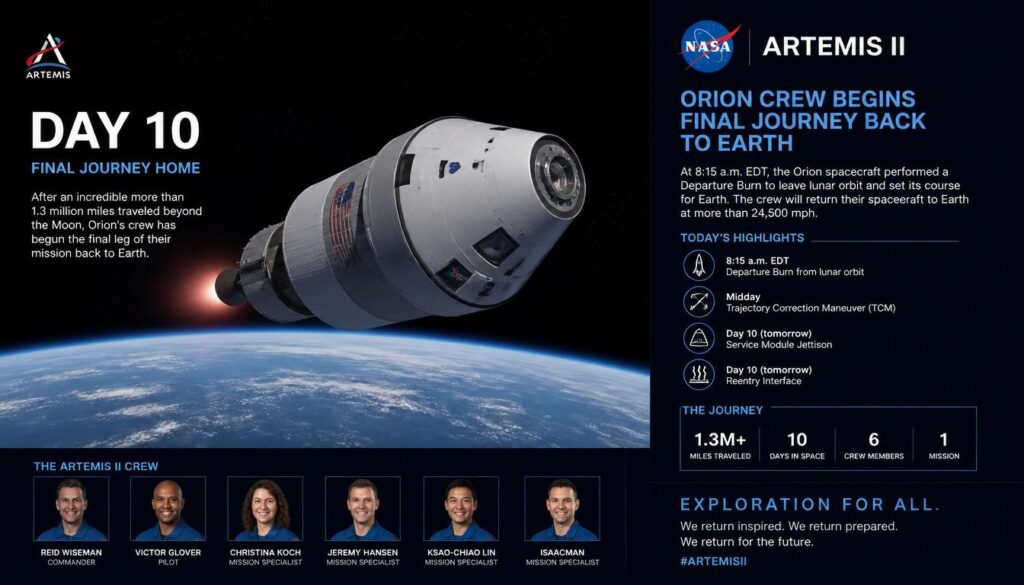
Orion Service Module Separation Begins Re-Entry Sequence
One of the most crucial phases of re-entry happens around 7:33 p.m., when the crew module of Orion detaches from the service module. Throughout the mission, the service module provided Orion with power, propulsion, oxygen, and life support resources. However, it is not designed to survive atmospheric re-entry and must separate before the crew capsule enters Earth’s atmosphere.
Once separation occurs, Orion’s heat shield becomes fully exposed and prepared to withstand the intense temperatures generated during descent.
NASA expects the spacecraft to encounter temperatures of nearly 3,000 degrees Fahrenheit during re-entry.
This phase represents one of the most technically challenging portions of the mission because the spacecraft must remain stable and properly aligned while traveling at extraordinary speeds.
Orion Executes Final Entry Burn Before Atmospheric Interface
Shortly after service module separation, Orion will perform another important maneuver known as the crew module raise burn.
Scheduled for 7:37 p.m., this 18-second burn helps establish the correct entry angle and properly align Orion’s heat shield before the spacecraft reaches the upper atmosphere.
Precise orientation is essential because Orion’s heat shield is specifically designed to absorb and redirect the massive heat generated during atmospheric entry.
The spacecraft will also begin a series of controlled maneuvers to maintain stability and ensure safe descent toward the Pacific Ocean landing zone.
These operations demonstrate the advanced engineering behind Orion and NASA’s deep-space exploration systems.
Orion Will Reach Extreme Speeds During Re-Entry
As Orion begins descending through Earth’s atmosphere, the spacecraft will travel at nearly 35 times the speed of sound.
At approximately 7:53 p.m., Orion will reach about 400,000 feet above Earth’s surface and begin its atmospheric entry phase.
During this stage, the spacecraft’s outer surface will encounter tremendous friction as it interacts with Earth’s atmosphere. This friction generates plasma around the capsule, temporarily blocking communications between Orion and mission control.
NASA expects the communications blackout to last approximately six minutes.
Inside the spacecraft, the astronauts are expected to experience forces of up to 3.9 Gs during descent, meaning they will temporarily feel almost four times their normal body weight.
Although physically demanding, these forces remain within safe limits for trained astronauts.
Orion’s Parachutes Will Slow the Spacecraft for Landing
Following atmospheric entry and the communications blackout, Orion will begin deploying its parachute systems to safely slow the spacecraft before splashdown.
At approximately 8:03 p.m., Orion’s drogue parachutes will deploy at around 22,000 feet above the ocean. These smaller parachutes help stabilize and slow the capsule during the early stages of descent.
One minute later, at approximately 6,000 feet above the Pacific Ocean, the drogue parachutes will release and Orion’s three massive main parachutes will fully deploy.
The main parachutes are designed to reduce Orion’s descent speed to less than 136 miles per hour before splashdown.
By the time the spacecraft reaches the ocean surface, Orion’s speed will slow to approximately 20 miles per hour.
NASA engineers spent years testing Orion’s parachute systems to guarantee reliable performance during crewed missions.
Recovery Teams Prepare to Welcome Artemis II Astronauts
Once Orion safely splashes down, NASA and military recovery teams will immediately begin post-landing operations.
Divers and support crews will secure the spacecraft while assisting the astronauts out of the capsule. The crew will then board an inflatable raft before being transported by helicopter to the USS John P. Murtha.
The USS John P. Murtha acts as the main recovery vessel aiding Artemis II activities in the Pacific Ocean. After arriving aboard the vessel, the astronauts will undergo medical evaluations and health monitoring to help them readjust after spending days in deep space and microgravity conditions.
Eventually, the crew will go back to NASA’s Johnson Space Center in Houston to take part in further post-mission tasks and debriefings.
Artemis II Marks Humanity’s Return to Deep Space Exploration
The Artemis II mission began on April 1 with the successful launch of NASA’s Space Launch System (SLS) rocket from Kennedy Space Center in Florida.
The mission represents humanity’s first crewed journey around the Moon since the Apollo era ended in 1972.
Throughout the mission, NASA tested Orion’s systems in the harsh environment of deep space while astronauts conducted operational demonstrations and spacecraft evaluations.
Artemis II serves as a critical stepping stone for future lunar landing missions and NASA’s long-term goal of establishing a sustainable human presence on the Moon.
The mission also helps prepare technologies and operational procedures for eventual human exploration of Mars.
As Orion prepares to splash down in the Pacific Ocean, Artemis II continues inspiring millions of people worldwide and proving that a new era of human exploration has officially begun.
Frequently Asked Questions (FAQs)
What is the Artemis II mission?
Artemis II is NASA’s first crewed deep-space mission under the Artemis program designed to send astronauts around the Moon and back to Earth.
Who are the Artemis II crew members?
The four crew members are Reid Wiseman, Victor Glover, Christina Koch, and Jeremy Hansen, an astronaut from the Canadian Space Agency.
What is the purpose of the third return correction burn?
The burn helps refine Orion’s trajectory to ensure safe atmospheric re-entry and accurate splashdown.
Where is Orion scheduled to splash down?
The planned landing location for Orion is a splashdown in the Pacific Ocean, just off the coast of San Diego, California.
How hot will Orion become during re-entry?
The spacecraft is expected to encounter temperatures of approximately 3,000 degrees Fahrenheit during atmospheric entry.
Why does Orion experience a communications blackout?
Plasma forms around the spacecraft during re-entry, temporarily blocking radio communication with mission control.
How fast will Orion travel during atmospheric entry?
During re-entry, Orion will move at a speed close to 35 times the speed of sound.
What is the role of Orion’s parachutes?
The parachutes slow and stabilize the spacecraft before splashdown in the Pacific Ocean.
What is the USS John P. Murtha?
The USS John P. Murtha is the recovery ship responsible for supporting astronaut recovery operations after splashdown.
Why is Artemis II important?
Artemis II is a major milestone in NASA’s plan to return humans to the Moon and prepare for future missions to Mars.