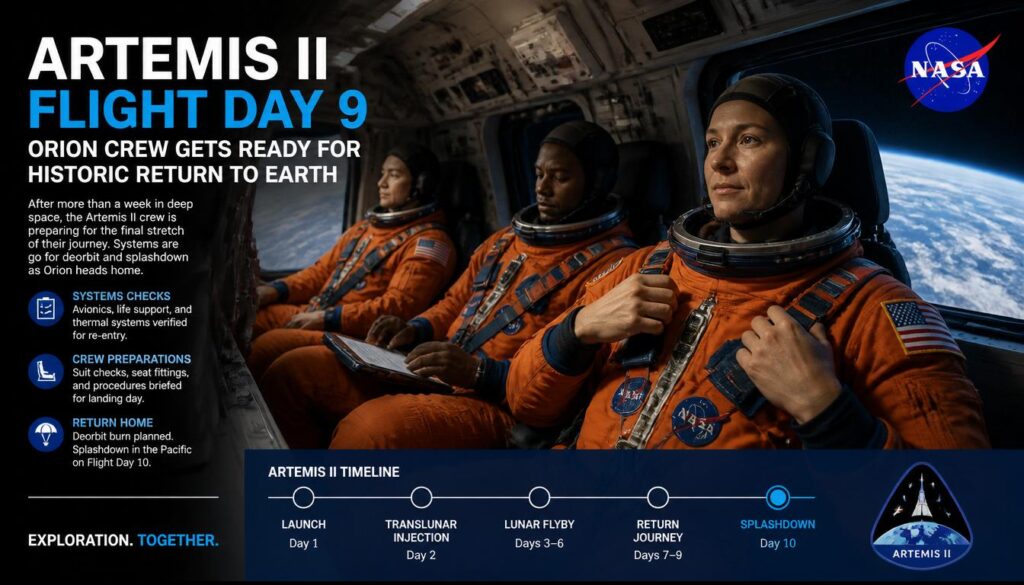
Artemis II Flight Day 9: Orion Successfully Completes Second Return Correction Burn

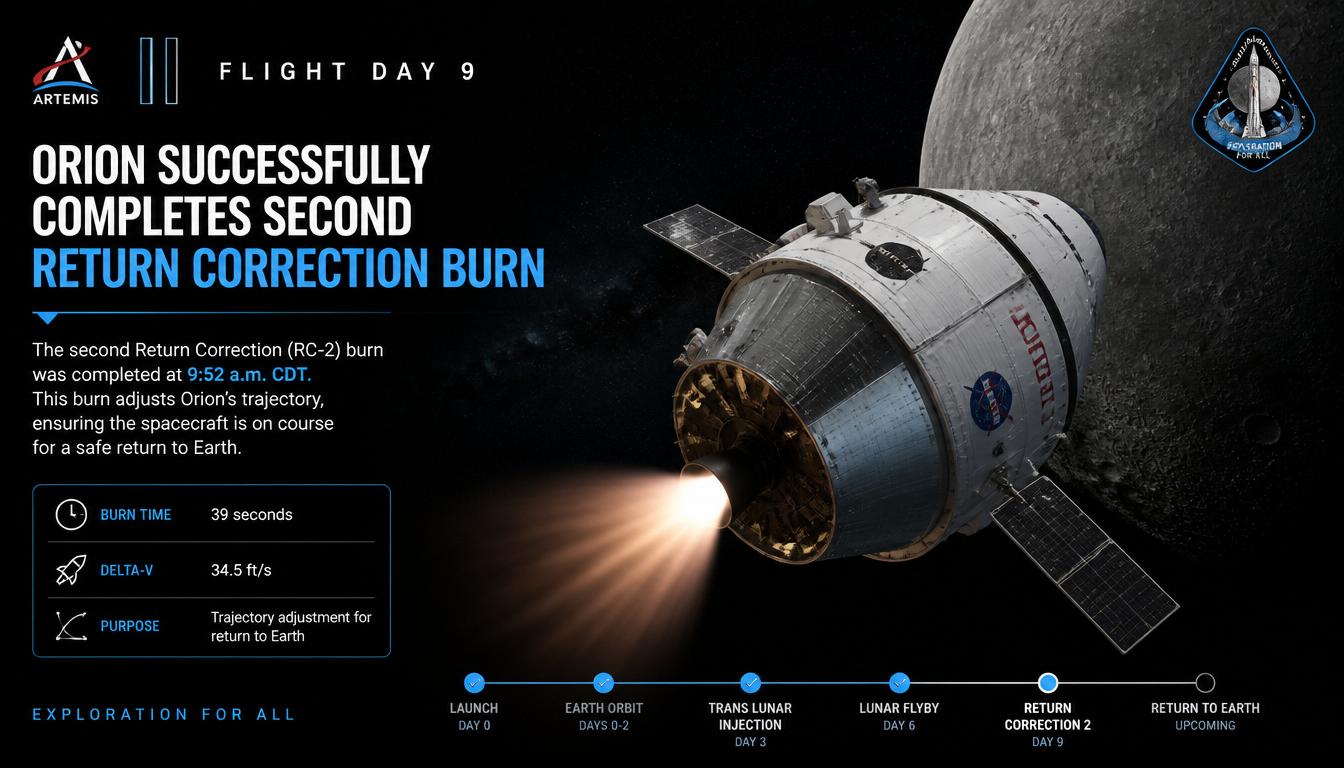
Artemis II Flight Day 9: Orion Successfully Completes Second Return Correction Burn
NASA’s Artemis II mission continues progressing successfully as the Orion spacecraft completed another important maneuver during its return journey to Earth. On Flight Day 9, the spacecraft carried out the second return correction burn, helping guide the crew safely back home after their historic mission around the Moon.
The Artemis II astronauts are now more than halfway through their journey back to Earth as NASA prepares for Orion’s scheduled splashdown in the Pacific Ocean. The mission remains one of the agency’s most important deep-space operations in decades and serves as a major step toward future human exploration of the Moon and Mars.
During this phase of the mission, astronauts and mission controllers are focusing on navigation accuracy, spacecraft systems, re-entry procedures, and final splashdown preparations.
Orion Spacecraft Performs Successful Return Correction Burn
One of the biggest achievements on Flight Day 9 was the successful completion of Orion’s second return trajectory correction burn. At 10:53 p.m. EDT, the spacecraft fired its thrusters for approximately nine seconds.
Although the burn lasted only a short time, it produced a velocity increase of 5.3 feet per second, helping fine-tune Orion’s trajectory toward Earth.
Trajectory correction burns are extremely important during deep-space missions because spacecraft travel across enormous distances. Even small navigation adjustments can significantly affect the final landing path and re-entry accuracy.
NASA engineers carefully monitor these burns to ensure Orion remains aligned with its planned return corridor.
The successful maneuver confirmed that Orion’s propulsion and navigation systems continue performing as expected during the critical return phase of the mission.
Artemis II Crew Continues Historic Journey Home
The Artemis II crew includes NASA astronauts Reid Wiseman, Victor Glover, Christina Koch, and Canadian Space Agency astronaut Jeremy Hansen.
After completing their historic flyby around the Moon, the astronauts are now traveling back toward Earth inside the Orion spacecraft. The mission has already become a landmark achievement in modern space exploration because it marks NASA’s first crewed deep-space mission under the Artemis program.
The astronauts spent several days conducting tests, monitoring spacecraft systems, capturing lunar imagery, and performing operational demonstrations while traveling around the Moon.
During the lunar flyby, the crew came within approximately 4,067 miles of the Moon’s surface, providing breathtaking views and collecting valuable scientific data.
NASA astronaut Victor Glover was photographed inside Orion during the mission while observing the Moon through the spacecraft windows. The astronauts reportedly spent nearly seven hours taking turns at Orion’s windows capturing imagery and scientific observations to send back to Earth.
These observations provide scientists and engineers with important information that will help improve future lunar exploration missions.
Temporary Communication Loss During Flight Day 9
Before the return correction burn took place, NASA encountered an unexpected communication issue involving Orion’s return link signal.
Approximately two hours before the scheduled maneuver, mission controllers detected a loss of signal during a data rate change affecting communications and telemetry transmission between the spacecraft and ground control.
Telemetry systems are essential because they allow NASA teams to monitor spacecraft performance, crew status, navigation data, and onboard systems in real time.
Although the issue temporarily interrupted communication, NASA flight controllers quickly worked to restore the connection. Two-way communications between Orion and mission control were successfully reestablished shortly afterward.
Once communications returned, mission teams resumed preparing the spacecraft and crew for the upcoming trajectory correction burn.
The quick recovery demonstrated the effectiveness of NASA’s flight control teams and Orion’s communication systems during unexpected situations.
NASA Officials Share Re-Entry and Splashdown Updates
Earlier in the day, NASA officials held another mission status briefing to provide updates about Artemis II’s return operations and splashdown preparations.
During the briefing, agency representatives discussed Orion’s re-entry procedures, recovery operations, and the spacecraft’s expected splashdown timeline.
NASA continues sharing detailed mission updates with the public because the Artemis II mission represents a major milestone in human spaceflight.
The agency has also released diagrams and visual presentations explaining Orion’s entry, descent, parachute deployment, and splashdown sequence.
These updates help audiences worldwide understand the complex operations involved in safely returning astronauts from deep space.
Third Return Trajectory Correction Burn Scheduled
NASA has already scheduled Orion’s third return trajectory correction burn for April 10 at approximately 1:53 p.m.
This final correction maneuver will further refine the spacecraft’s flight path before atmospheric re-entry begins later that day.
Multiple trajectory correction burns are common during long-duration space missions because they allow engineers to maintain extremely precise control over spacecraft positioning.
The final burn will help ensure Orion enters Earth’s atmosphere at the correct angle and location. Entering too steeply or too shallowly could create dangerous conditions for the spacecraft and crew.
NASA’s mission planning teams carefully calculate every maneuver to maximize astronaut safety and landing accuracy.
Splashdown Planned Off the Coast of San Diego
NASA currently plans for splashdown to occur at 8:07 p.m. EDT on Friday, April 10, in the Pacific Ocean near San Diego, California.
Splashdown operations involve coordination between astronauts aboard Orion and large recovery teams stationed in the Pacific Ocean.
Once the spacecraft lands safely in the ocean, recovery crews will quickly approach Orion to secure the capsule and assist the astronauts.
The USS John P. Murtha serves as the primary recovery vessel supporting Artemis II operations. Recovery personnel include engineers, divers, medical teams, Navy specialists, and NASA support staff.
The astronauts will undergo medical evaluations immediately after exiting Orion because returning from deep space and microgravity places unique stress on the human body.
NASA carefully rehearses splashdown and recovery procedures to ensure maximum safety and efficiency during the mission’s final phase.
Orion’s Return Represents a Major Deep-Space Milestone
The successful completion of Orion’s return correction burn highlights the advanced capabilities of NASA’s Artemis program and Orion spacecraft.
Artemis II is the first crewed mission designed to test Orion during a journey around the Moon and back to Earth. The mission serves as a critical step before future lunar landing missions planned under the Artemis program.
NASA’s long-term goal is to establish a sustainable human presence on the Moon and eventually prepare astronauts for missions to Mars.
Every operation conducted during Artemis II provides valuable experience and technical data for future exploration missions.
The mission also demonstrates international collaboration in space exploration through NASA’s partnership with the Canadian Space Agency.
As Orion continues its journey home, the success of Artemis II continues inspiring millions of people worldwide and opening a new era of deep-space exploration.
Importance of Navigation and Precision in Space Missions
Deep-space missions require extraordinary precision because spacecraft travel across millions of miles through space.
Trajectory correction burns may appear small compared to the overall mission, but they play a critical role in ensuring spacecraft arrive at their exact destination safely.
NASA engineers continuously track Orion’s position, speed, and orientation using advanced navigation systems and communication networks.
Every adjustment made during the mission helps protect the astronauts and ensures Orion remains on the safest possible path back to Earth.
The Artemis II mission highlights how modern space exploration depends on teamwork between astronauts, engineers, scientists, and mission control specialists working together across multiple locations.
Artemis II Inspires the Future of Human Exploration
Beyond its technical successes, Artemis II reflects humanity’s continuing aspiration to venture into deep space and go beyond past limits.
The mission is inspiring future generations of scientists, engineers, astronauts, and students interested in space exploration.
NASA hopes the Artemis program will eventually establish long-term exploration missions on the Moon while preparing technologies and systems needed for future journeys to Mars.
The successful operations performed during Flight Day 9 bring the mission one step closer to a safe conclusion and demonstrate the incredible progress being made in human spaceflight.
As Orion approaches Earth, the world continues watching one of NASA’s most important modern exploration missions unfold.
Frequently Asked Questions (FAQs)
What was the purpose of Orion’s second return correction burn?
The burn adjusted Orion’s trajectory to ensure the spacecraft remains on the correct path for safe re-entry and splashdown.
How long did the second return correction burn last?
The spacecraft’s thrusters fired for approximately nine seconds.
How much velocity did the maneuver add to Orion?
The burn increased Orion’s velocity by approximately 5.3 feet per second.
Did Artemis II experience communication problems?
Yes, NASA experienced a temporary loss of communication and telemetry before the burn, but engineers quickly restored the connection.
Who are the Artemis II astronauts?
Reid Wiseman, Victor Glover, Christina Koch, and Canadian Space Agency astronaut Jeremy Hansen are the members of the crew.
How close did Orion come to the Moon?
At closest approach, Orion traveled within approximately 4,067 miles of the Moon’s surface.
When is the third return correction burn scheduled?
NASA scheduled the third correction burn for April 10 at approximately 1:53 p.m.
Where will Artemis II splash down?
The spacecraft is expected to splash down in the Pacific Ocean near San Diego, California.
What is the role of the USS John P. Murtha?
The USS John P. Murtha serves as the primary recovery ship for the Artemis II mission.
Why are trajectory correction burns important?
These maneuvers help maintain precise spacecraft navigation and ensure safe atmospheric re-entry and landing.